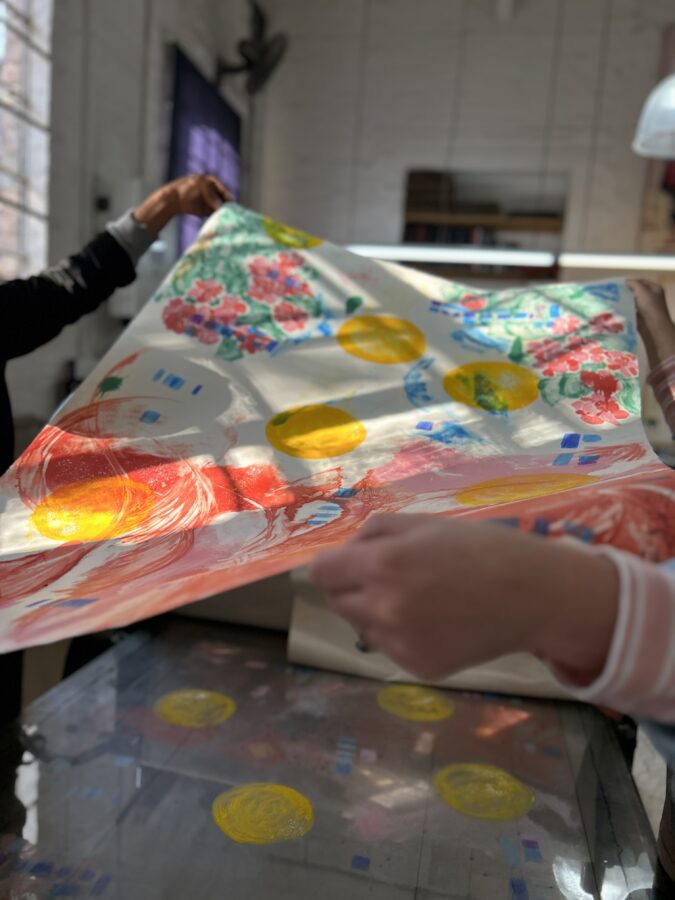
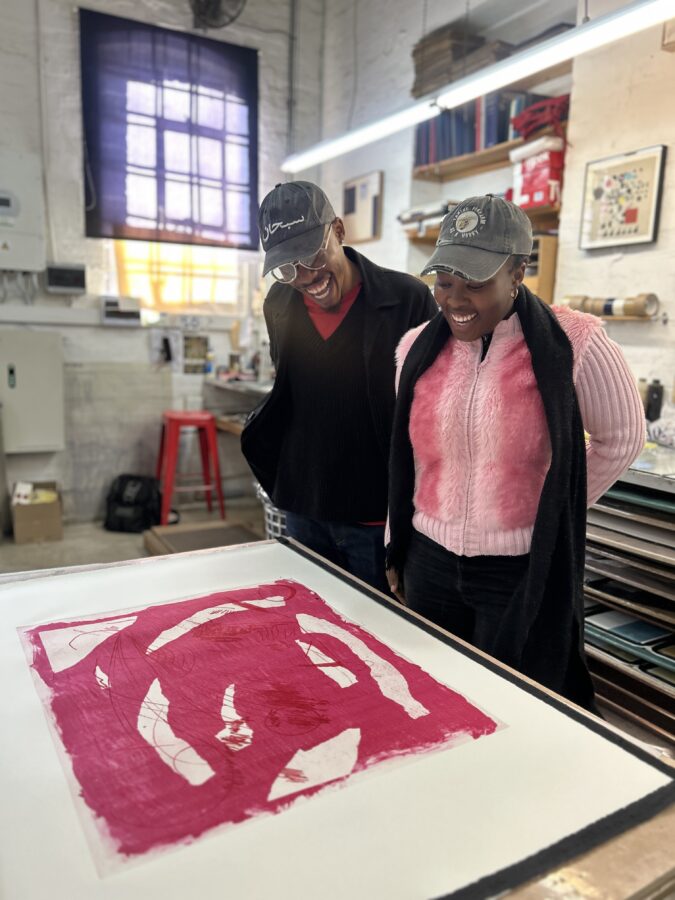
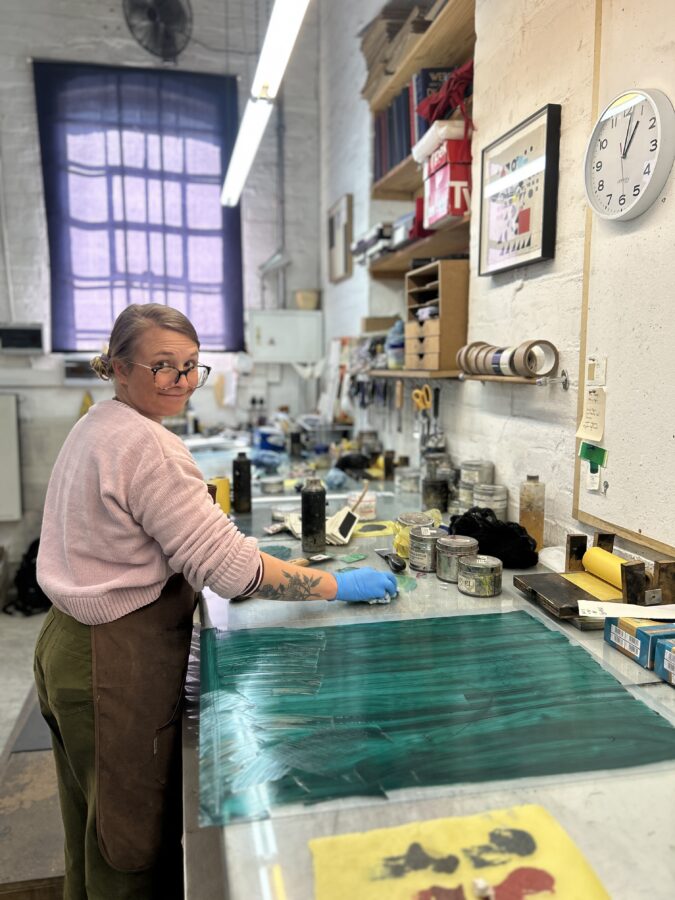
When Nkhensani Mkhari arrives at David Krut Workshop, he enters ready for action—as if the hours spent elsewhere have been a slow fermentation of ideas, synthesising and processing the world around him. The moment his brush meets ink or his hand connects with the roller, marks begin to spill across the perspex. What follows is a steady, purposeful flow of work.
This latest body of work, created in close collaboration with printer Roxy Kaczmarek, emerged in anticipation of the FNB Joburg Art Fair. It’s a collection that speaks directly to the concerns of contemporary practice—layered, thoughtful, and urgent.
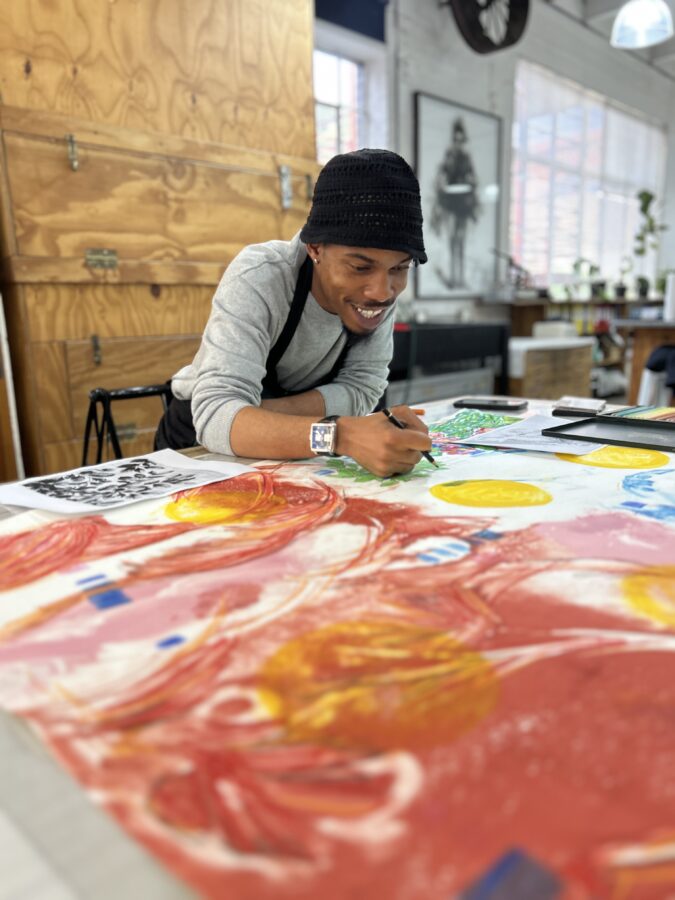
Maps, science fiction, magical realism, trees and forests, cross-pollination, roots, botanicals and the cultivation of beauty, post-planetary design, displacement, epidemic dissidence and game theory. These are some of the things that have accompanied me across oceans and cities, by land and by plane, and they found their way into the studio with me. I work as a travelling curator, writer and artist, moving through a tripartite scheme that forms and informs my praxis and my modes of thinking. Making this body of work was a form of catharsis, a space to test out and project my thoughts, intuitions and feelings into a visual field through material form. Music in the studio ran through most of the sessions, and something of its looseness settled into the marks.
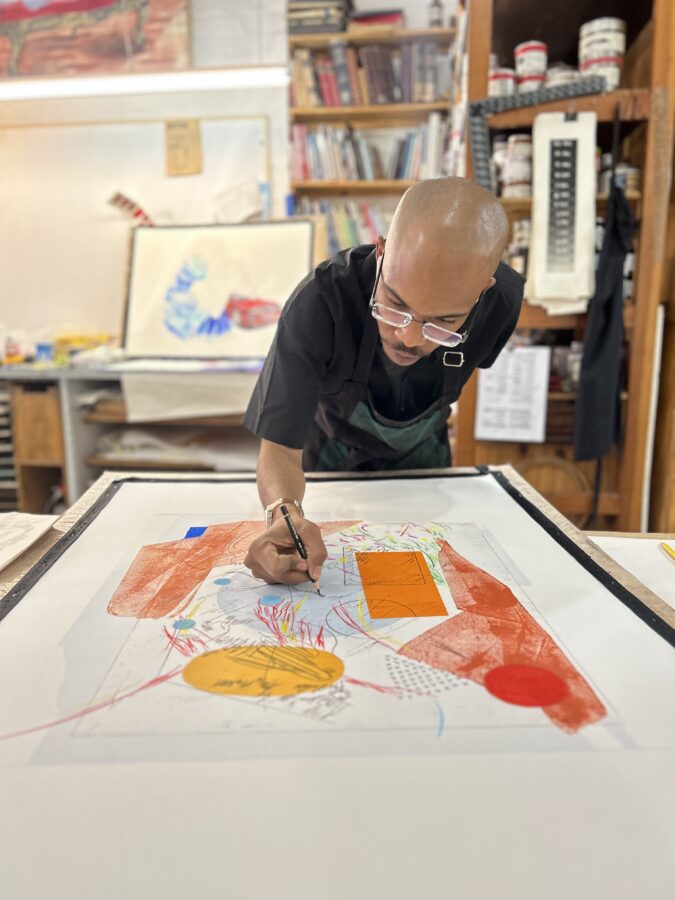
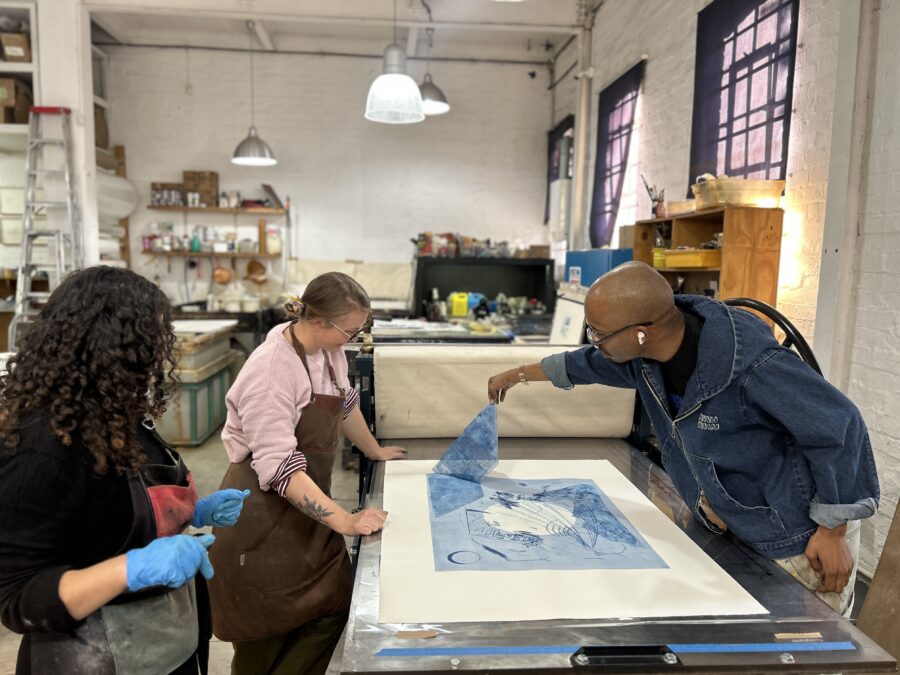
The works hold these preoccupations loosely, the way a garden holds its seasons. Four Seasons, Summer burns through reds and yellows, its suns rising and setting inside the same frame. Earth reads like a green atmosphere crossed by flight paths and orbits, a planet seen from somewhere just outside it. ‘Tardigrade’, carries a fragment of a dictionary entry inside its cool blue field, the small indestructible creature becoming a way to think through survival and deep time. ‘Chemical Wedding’, gathers its alchemy from cross-pollination and transformation, botanical scribbles meeting geometric bodies. ‘Going Home’, saturates everything in a single magenta breath. Across all of them the recurring threads are maps and migration, forests and displacement, the pull between where one is and where one is from.
Monotype printmaking is systematic. Over the past two years I have studied that system closely, and I have kept asking how I might modify the process, expand the contours of the medium, and at times surpass them. There are collages from found materials as usual, material juxtapositions and ghost prints, second pulls that hold onto what the first impression left behind, which feels right for work so preoccupied with trace, residue and return.
“Drypoint has always been about the burr, the ridge of displaced material that catches ink and gives the line its velvet weight, and traditionally that burr is coaxed out slowly, one deliberate pass of the needle at a time.”
Nkhensani Mkhari
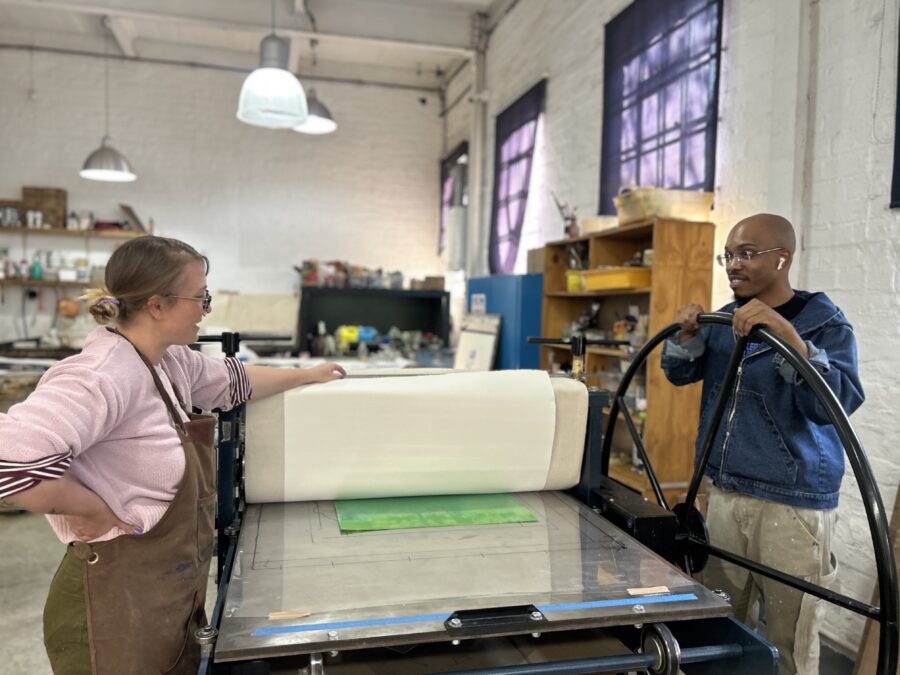
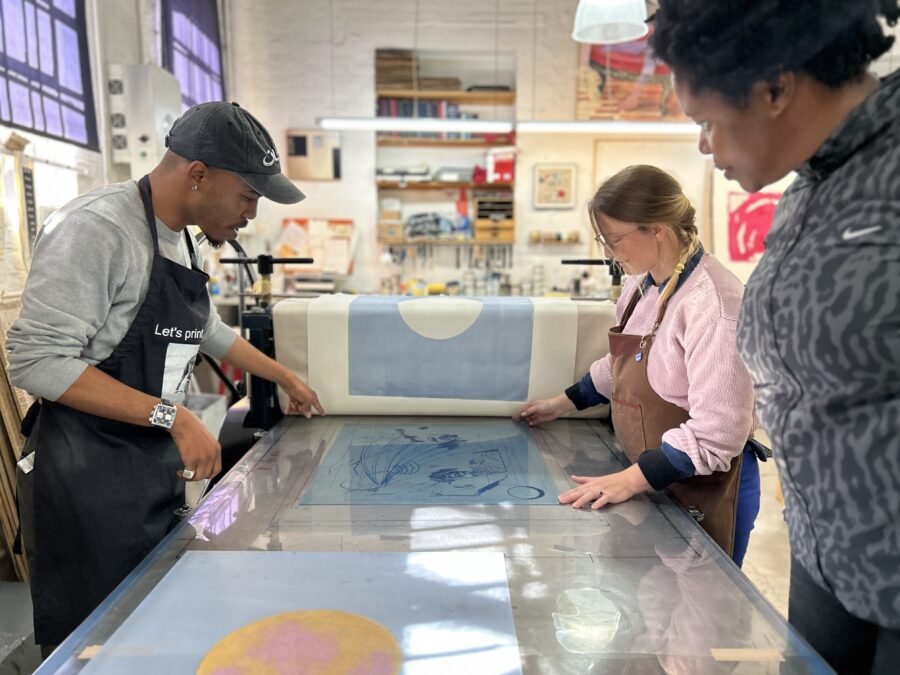
Central to Mkhari’s expanding technical range is drypoint—a medium of deliberate disturbance. He scratches and removes, scarring the perspex surface with intention. Ink is then wiped into these wounds; the excess is slowly scraped away to reveal the intricate marks beneath. The smaller works carry a quiet intelligence: they are fragments of larger pieces, born from a singular whole and resolved into individual studies. Sisters, brothers, cousins—a family of related forms.
The newly added marks come from drawing directly into the acrylic with a Dremel. What interests me is the tension it stages between the hand and the machine. Drypoint has always been about the burr, the ridge of displaced material that catches ink and gives the line its velvet weight, and traditionally that burr is coaxed out slowly, one deliberate pass of the needle at a time. Working into acrylic with the Dremel changes the terms entirely. The plastic cuts fast, almost too fast, and the tool wants to skate across the surface as much as bite into it. The burr it throws up is ragged and plastic, nothing like the soft metal ridge of copper drypoint, and it holds ink in its own unruly way. There’s a brittleness to the material that keeps me honest: push too hard and it chips or shatters, so the line carries a real risk in it. I’m not using the machine to be precise. I’m using it to reach marks that sit just outside what the hand can hold on its own, and then letting the tool, the vibration, and the resistance of the plastic argue with me on the plate. What the machine makes possible is not efficiency but a different register of gesture, where the pressure of the tool and the give of the acrylic are doing as much of the drawing as I am.
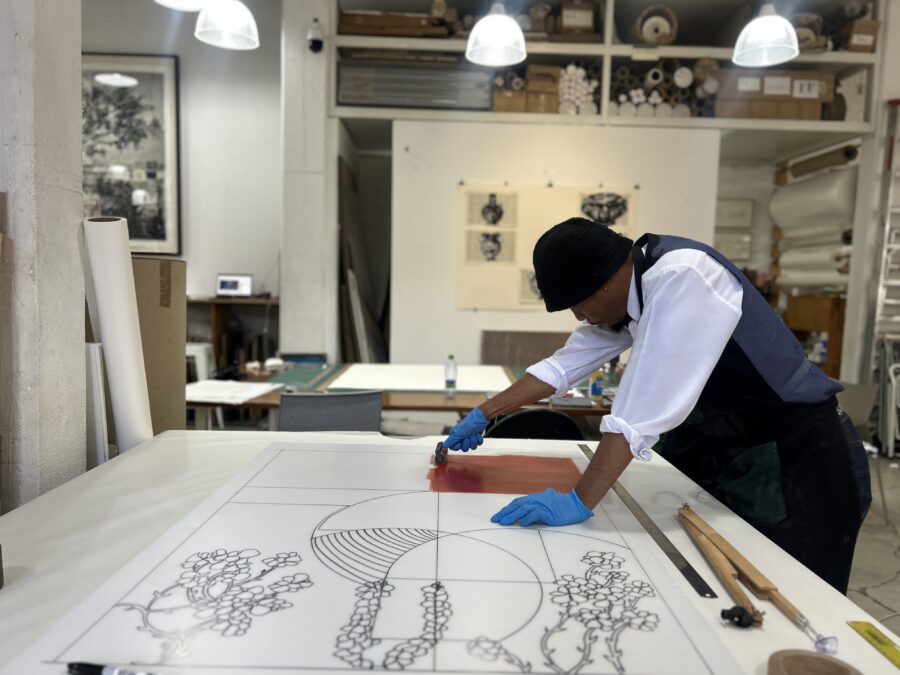
This new body of work will debut at FNB Art Joburg alongside works by other artists who have collaborated with the David Krut Workshop, as part of a project titled In Good Company. When Mkhari is not travelling, he does not maintain a dedicated physical studio; instead, he translates his experiences into visual works while working at the Workshop. With this in mind, the art fair project will foreground his working practice through an influx of works by artists from the community with whom he shares the space during his time at the Workshop.
Read about Nkhensani’s previous work done at the DKW below.