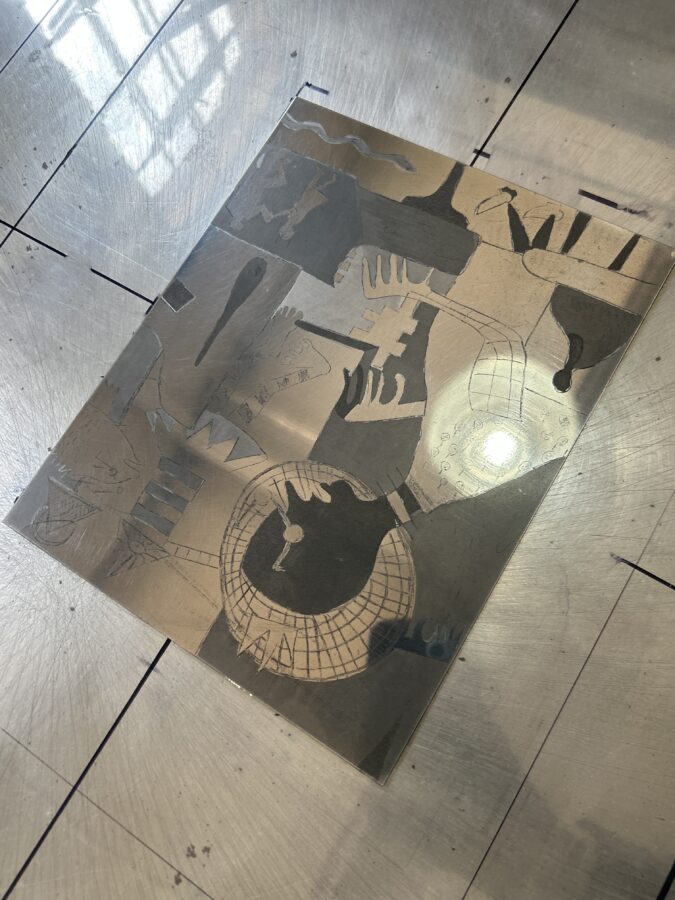
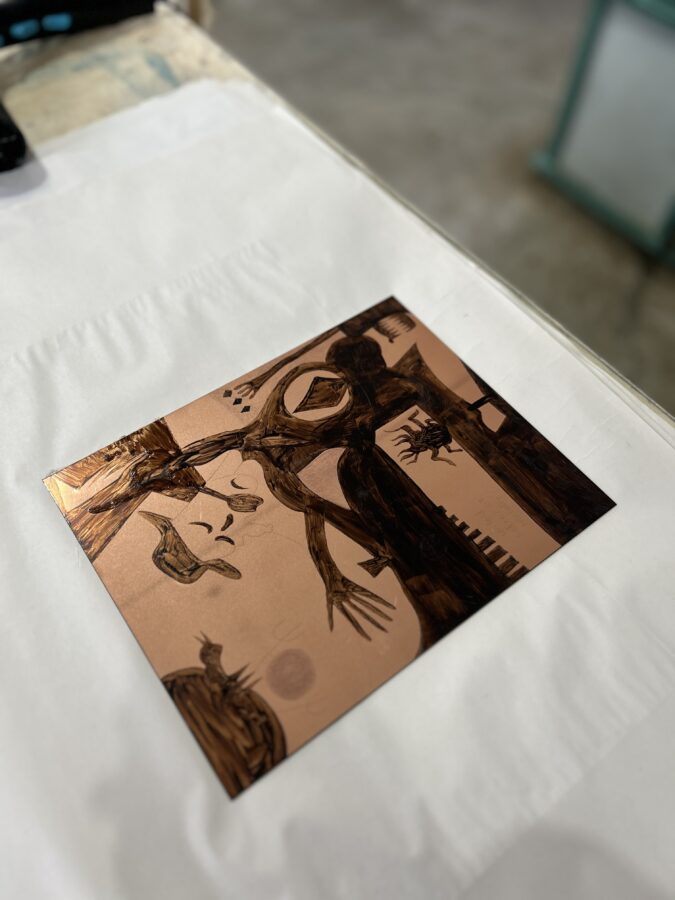
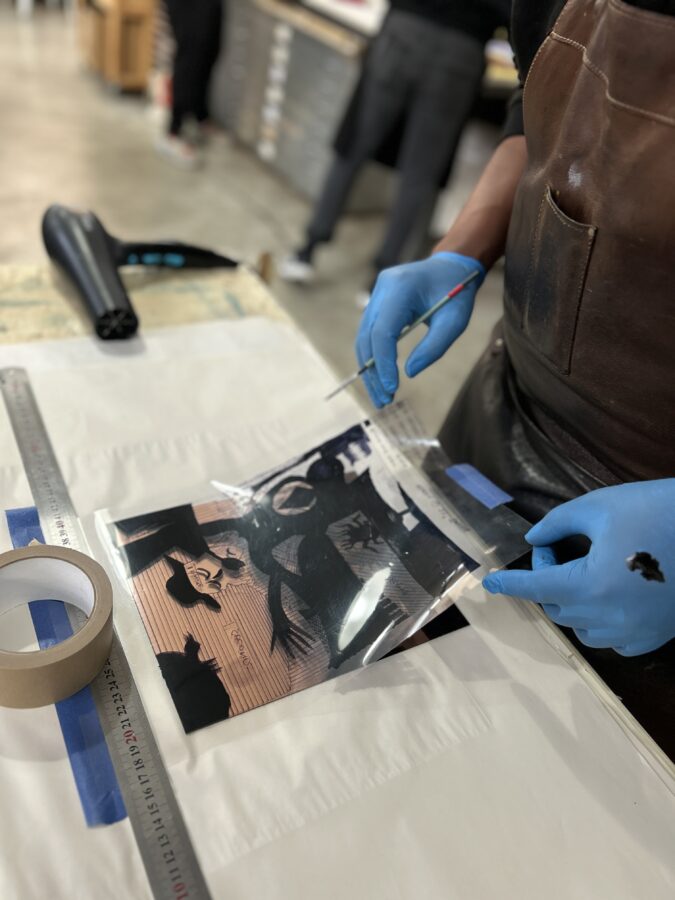
Throughout his reflections on the Excursion Series, Blessing Ngobeni repeatedly turns to the language of music. He speaks of rhythm, improvisation, orchestration and score. For Ngobeni, healing is composition, tears are melody and life is in the invisible frequencies that surround us. In his first sustained engagement with intaglio printmaking, music is not used as a guiding motif but rather an informant; of structure, composition, movement and style. Through the direction of the etching needle, the plate and the press, what was once a painterly eruption is now re-articulated, inscribed and filled with spirit anew.
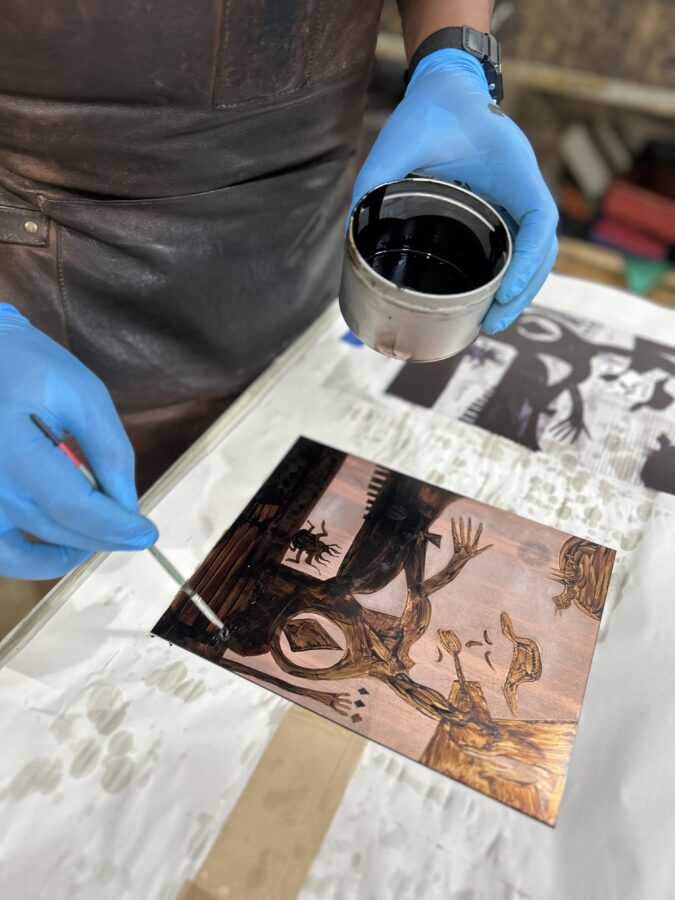
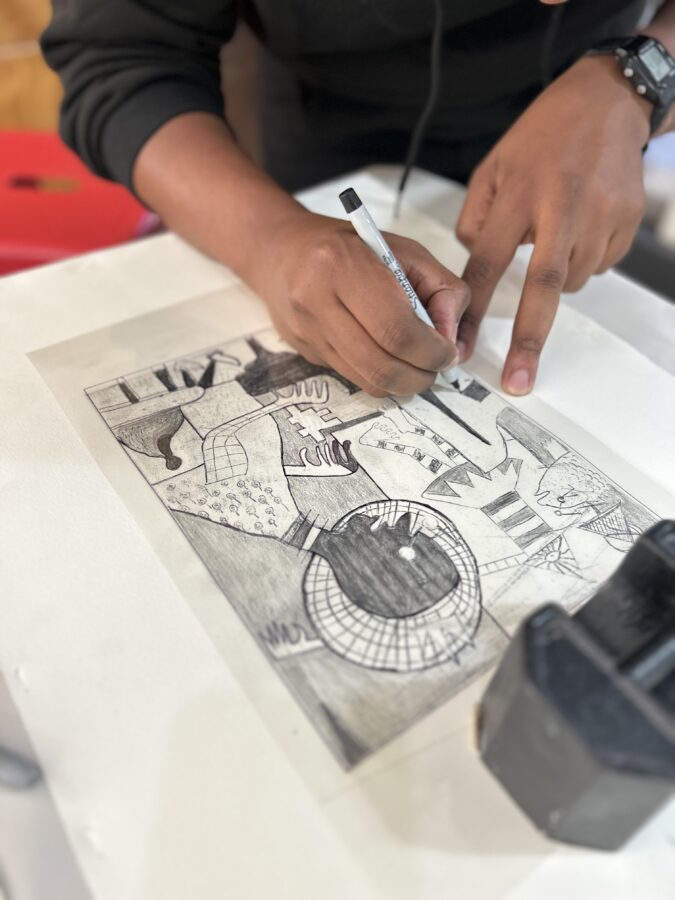
Intaglio introduces a different kind of discipline to Ngobeni’s African-Expressionist intensity. Unlike painting, which allows for spontaneous gesture, etching requires patience and precision. Every line must be carefully cut into the surface, and once made, it cannot be undone. This process naturally creates a tighter image. Yet Ngobeni does not lose his emotional urgency within this framework. Instead, it is concentrated into line, tone and form, and his characteristic rhythm and spirit now emerges through repetition and movement of line.
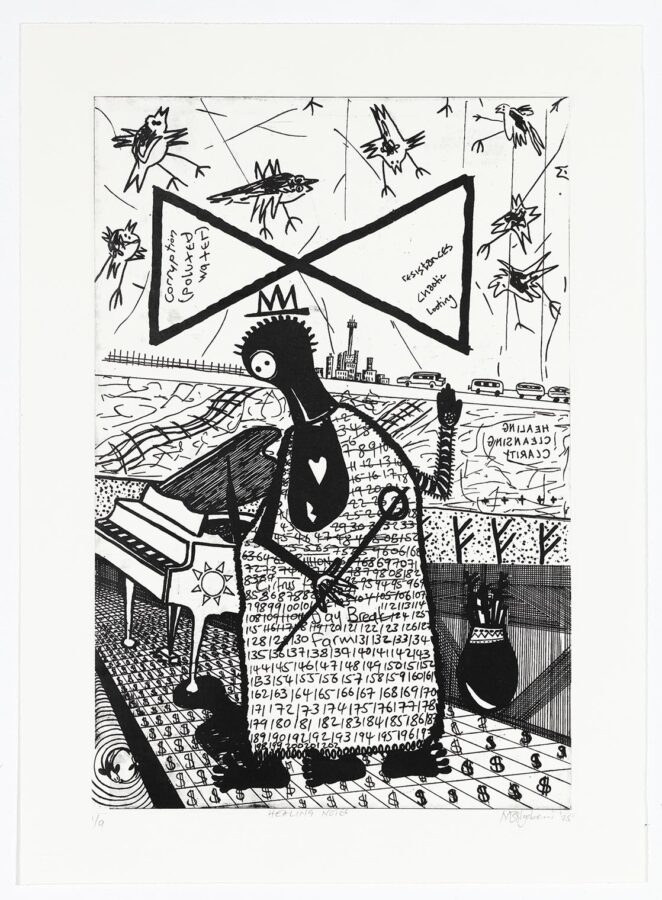
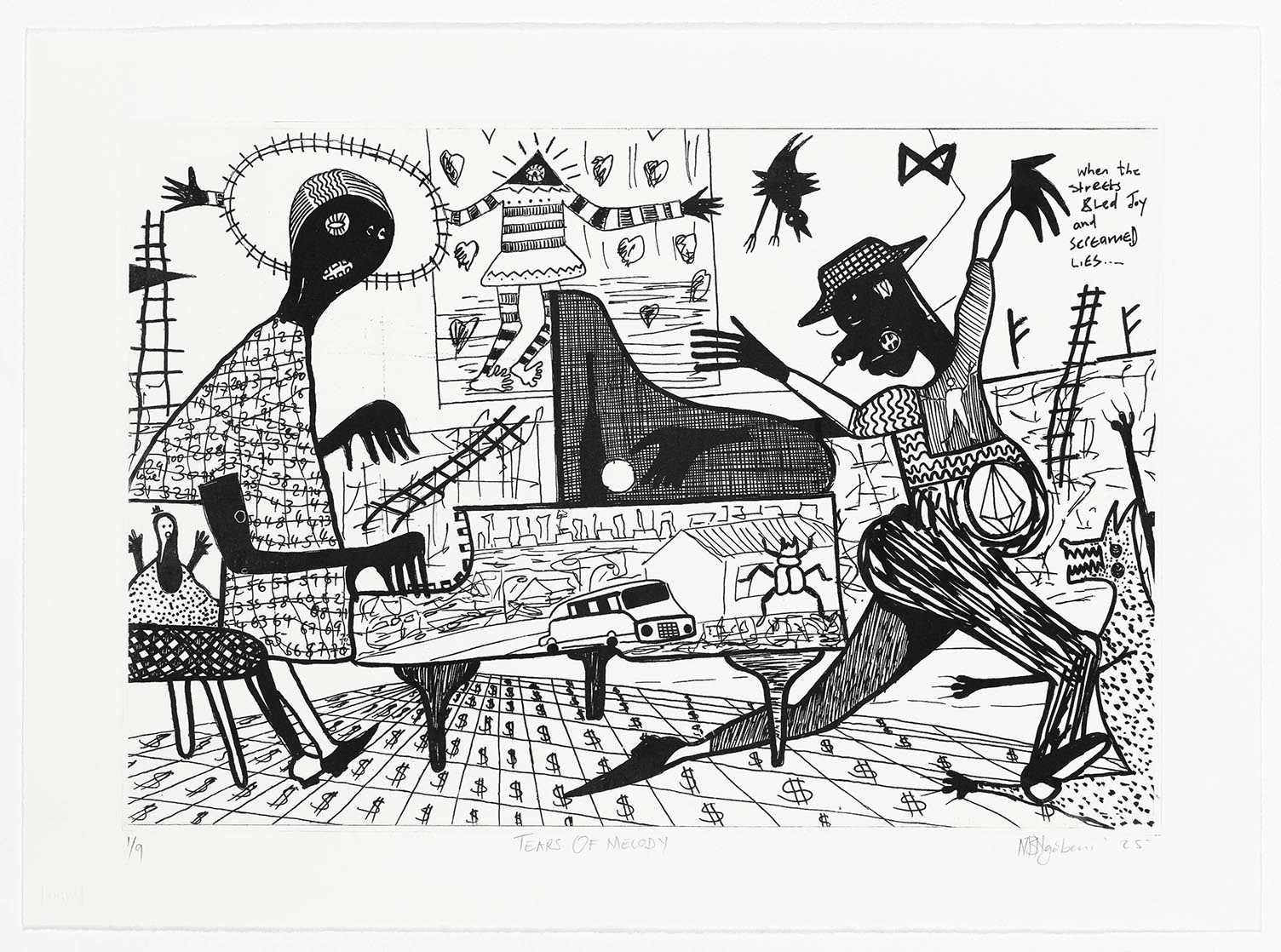
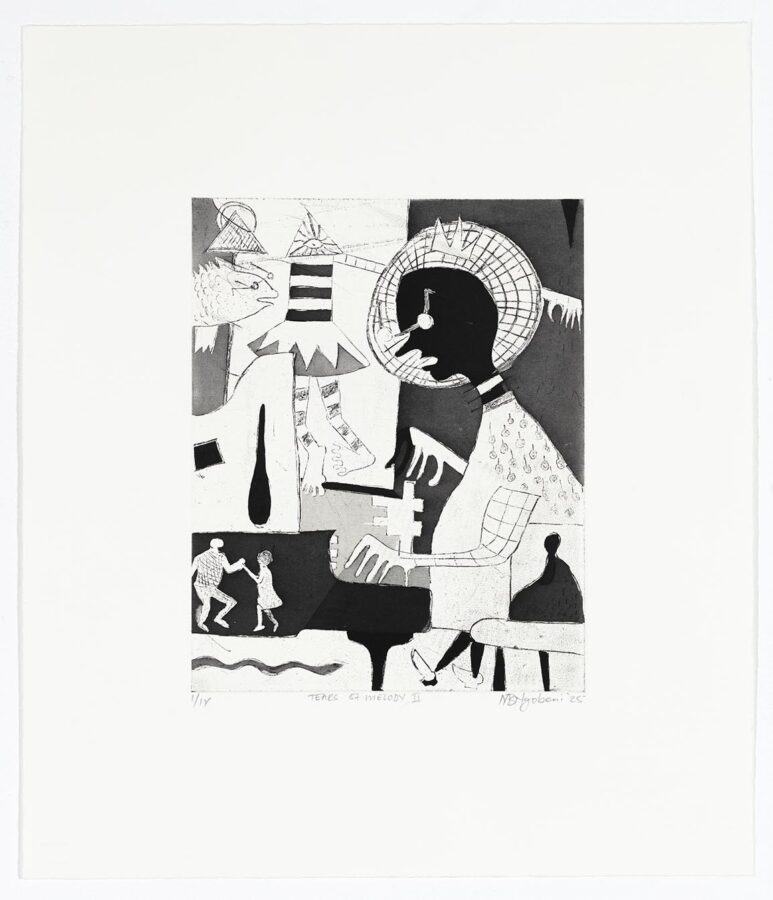
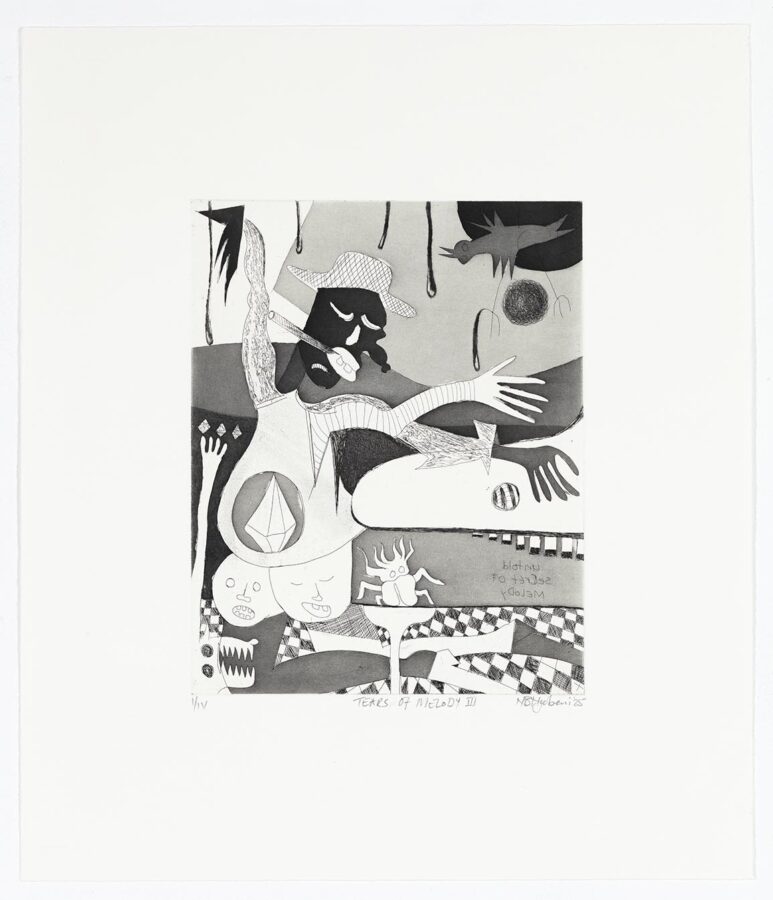
Within this inscribed framework, Ngobeni’s figurative language finds sharper definition. The figures we see are truly animated. Their simplified, geometric construction allows movement to read clearly. Angled limbs and tilted heads guide the eye across the surface, translating form into tempo and hands are consistently lifted in celebration, creation and release. In works such as Healing Notes and Tears of Melody, one can almost hear the low hum of a piano, the chatter of a lounge, the spill of drink and the sway of bodies in motion. The tonal weight achieved through aquatint, combined with the varied depth of burr and scratch from drypoint, creates shifting grounds that either press figures forward or allow them to exist quietly in the background. The figures feel active, suspended mid-movement, caught between the beats.
Healing Notes, 2025, Pronto Lithography, 49.5 x 36 cm
Tears of Melody, 2025, Pronto Lithography, 36 x 49.5 cm
Tears of Melody II, 2025, Soft-ground and aquatint etching, 43.4 x 37 cm
Tears of Melody III, 2025, Hard-ground and aquatint etching, 43.4 x 37 cm
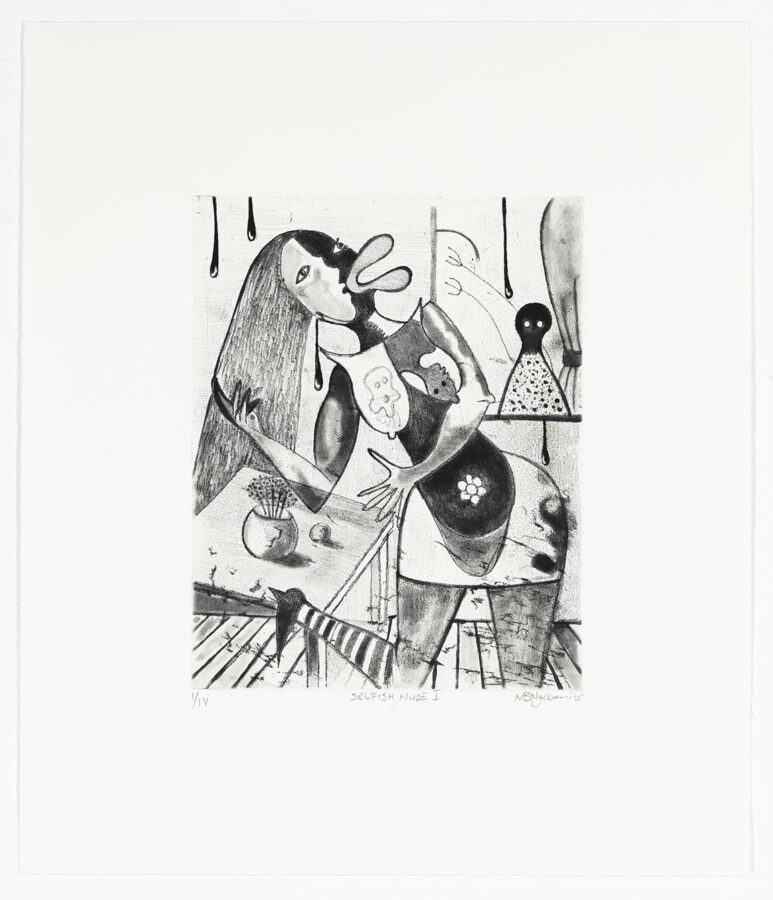
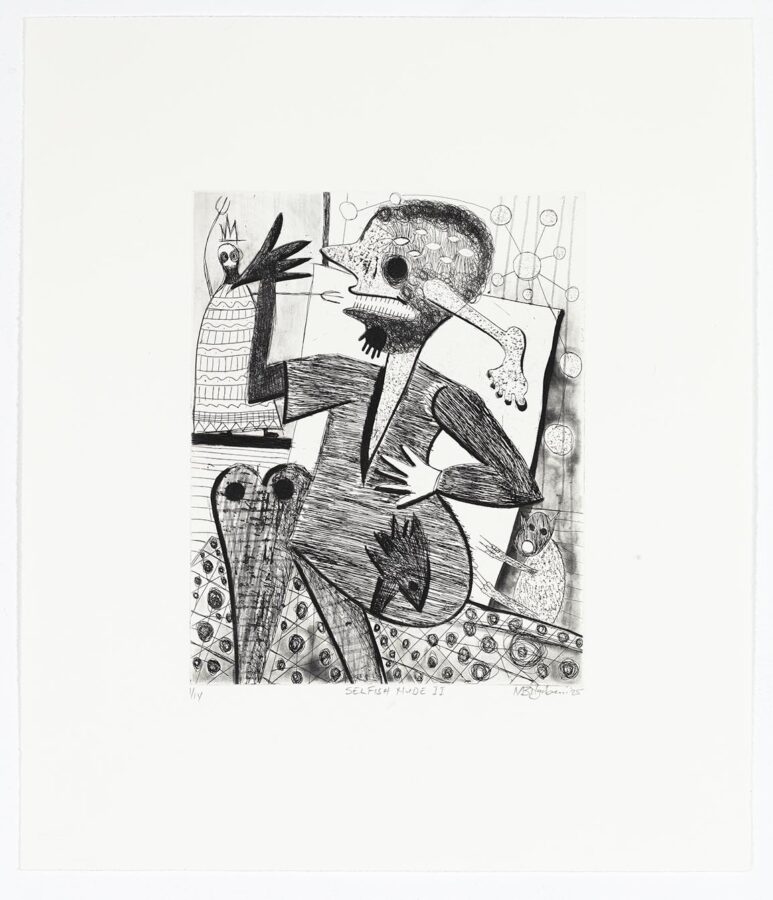
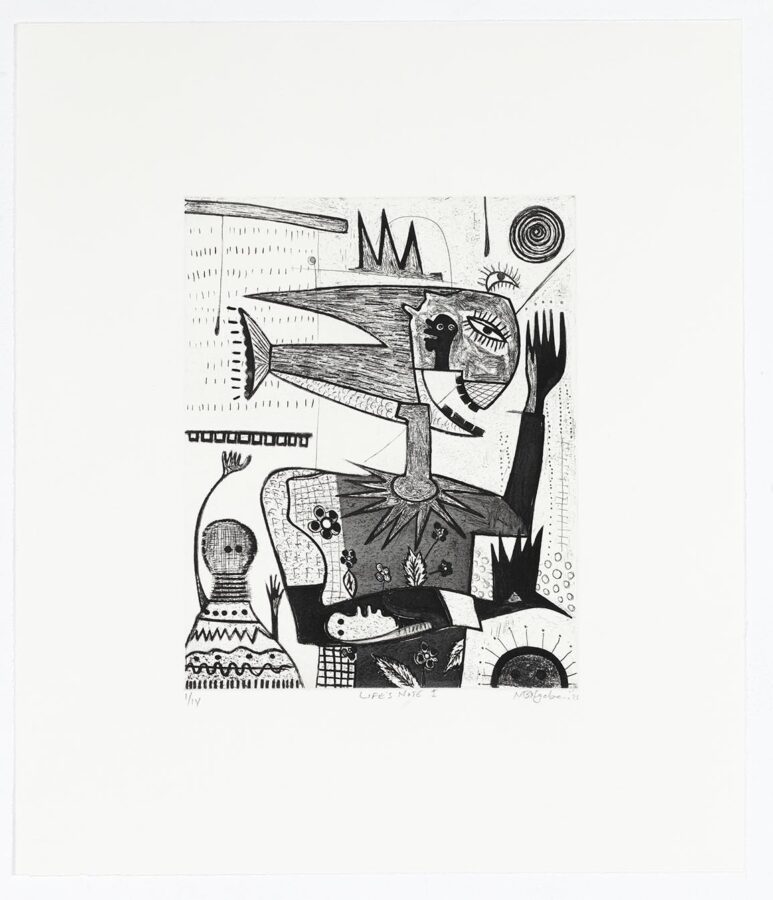
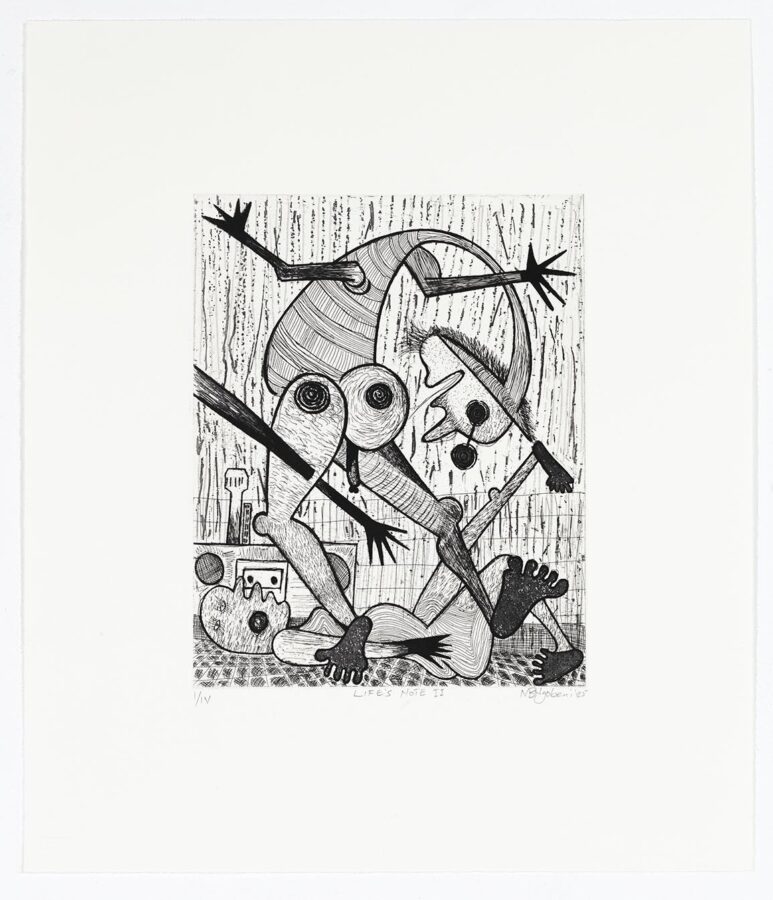
In Selfish Nude, this stylistic reduction serves a different purpose. The human form is pared back without exaggeration, broken down into essential planes, stripped of pretense. What remains is a figure neither idealised nor distorted for spectacle. In Life’s Notes, the simplicity of form and composition takes on a diaristic quality, like pages from a visual sketchbook. Repeated scratched lines, flowers, crowns and symbols fill negative space, creating rhythm through accumulation. The repetition is what establishes the tempo of the image. Across the series, Ngobeni’s figuration, layered tonal fields and recurring mark and symbols work together to build a world that feels lived-in and vibrantly in motion.
Selfish Nude I, 2025, Soft-ground and spit-bite etching with drypoint, 43.4 x 37
Selfish Nude II, 2025, Hard-ground with spit-bite and aquatint etching, 43.4 x 37
Life's Note I, 2025, Soft-ground and aquatint etching with drypoint, 43.4 x 37 cm
Life's Note II, 2025, Hard-ground and aquatint etching, 43.4 x 37 cm
Through this repetition, Ngobeni develops a system of visual signifiers that gradually consolidate a personal mythology. Birds, crowns, flowers, angel numbers, fragments of text and coded markings recur across the series as components of his growing visual language. These are not obscure symbols. They are everyday forms that carry collective associations; flight, authority, growth, divinity, protection, identity and so on. While the viewer is not privy to the precise meaning these symbols hold for Ngobeni, their recognisable nature invites viewers to project and interpret, allowing the imagery to resonate on both personal and shared registers. It is through repetition that this mythology takes shape. Like musical themes that return and deepen over time, the symbols gather weight with each appearance. Numbers and recurring marks reinforce the sense of notation, as though the surface were a coded score. The mythology is an evolving system, resulting in a visual code built through accumulation. For Ngobeni, meaning is structured through recurrence and sustained through rhythm.
In the Excursion Series, Ngobeni does not abandon the expressive force that has long defined his practice. Instead, he carries it into a new register. The shift to intaglio does not mute his intensity; it allows the viewer to have a different reading of his work. The musical language that guides his thinking becomes visible in the process itself, as incision replaces gesture and concise repetition gives the image its rhythm. His figures move within carefully built tonal fields, his symbols operate as recurring notes, and his marks gather into a language that feels both intimate and collective. What emerges is beyond an exercise in printmaking, but a scored mythology in which joy, rhythm, spirit and archetype are etched into permanence. In his movement in intaglio, Ngobeni conducts his own visual symphony.
Danijela Cook is a Johannesburg-based artist and writer whose practice moves between image and word. Her written work is driven by a passion for sharing stories in accessible ways that promote understanding and communication around contemporary artists and their work.
Drawing on popular culture, mythology, and the magic of the everyday, Cook’s practice reflects an ongoing engagement with different ways of communicating ideas, experiences, and perspectives. Across her work, she seeks to make the visual arts more accessible, creating entry points for broader audiences while amplifying the practice and presence of contemporary artists.