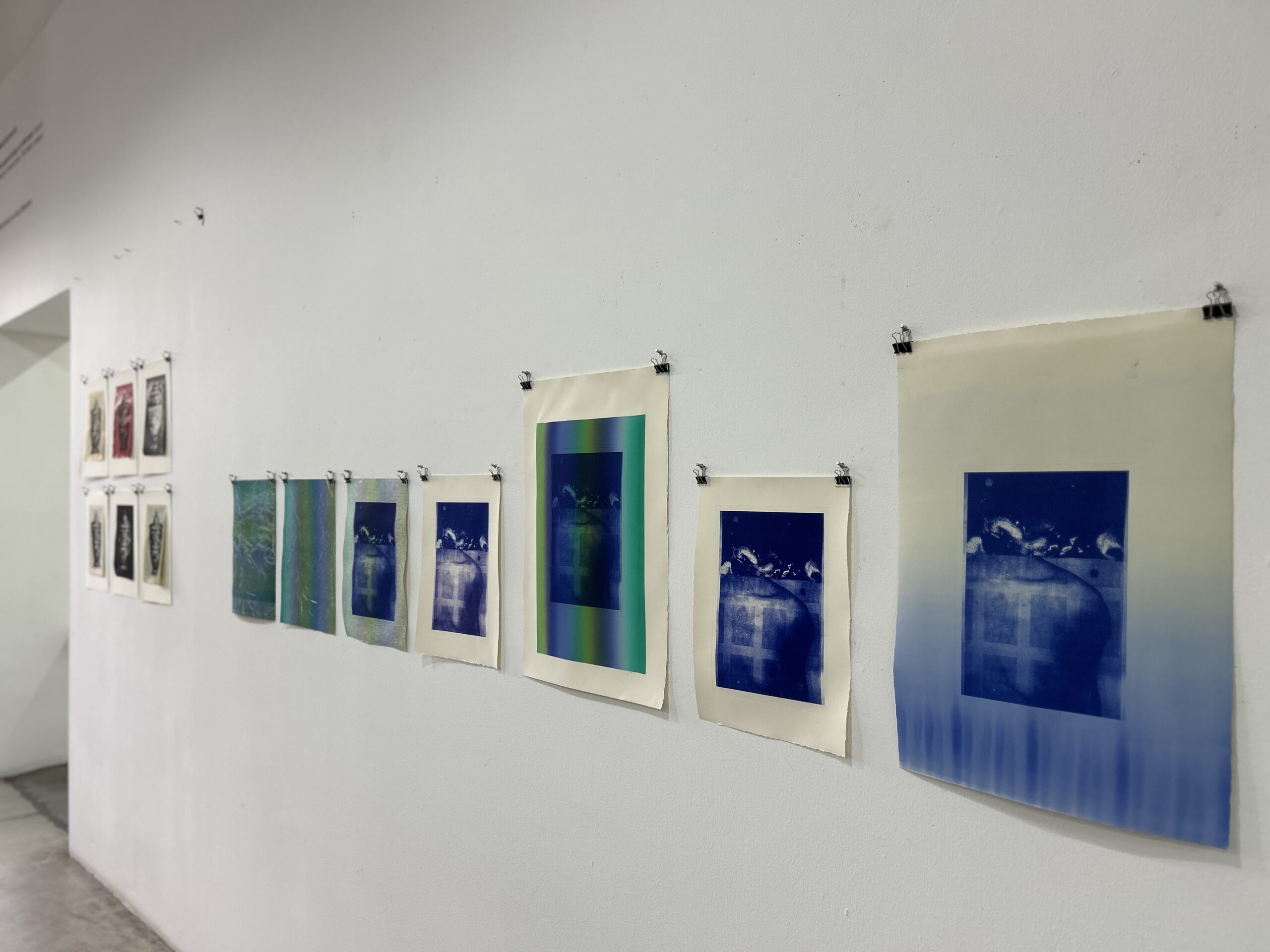
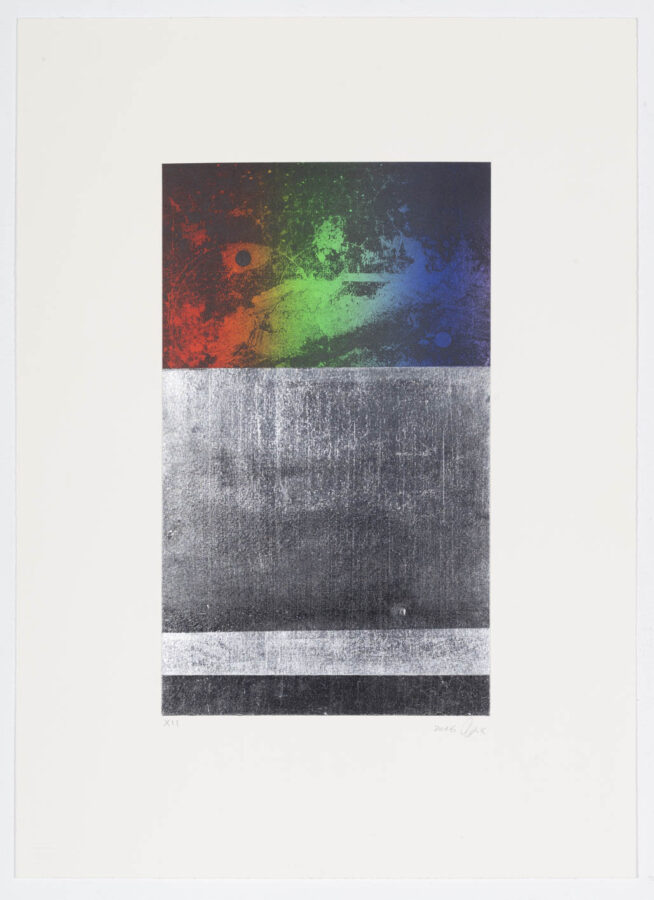
Images of Turpin’s early test prints, which he reffered to as prototypes (a combination of monotype and pronto lithograph)
M.J. Turpin (born 1982) is a South African contemporary artist, gallerist, and curator based in Johannesburg. Known for his provocative and interdisciplinary approach, he has become a central figure in the city’s art scene through both his personal practice and his influential gallery ventures through Kalashnikovv Gallery and later kumalo | turpin.
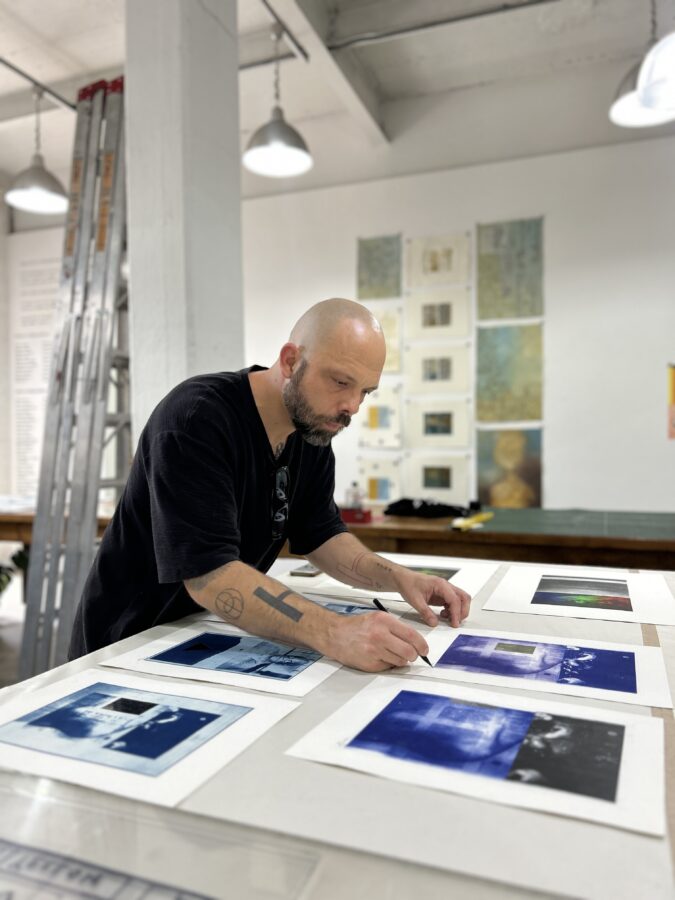
Turpin signing unique works done in collaboration with the DKW.
Khulu cropping down cyanotype prints for signing.
2026 marks Turpin’s first collaboration with the David Krut Workshop, resulting in a series of interdisciplinary prints created in collaboration with master printer Sbongiseni Khulu. Emerging from a personal collection of South African and international magazines gathered between 2002 and 2020, Turpin draws from a period when post-apartheid optimism intersected with rapid globalisation and the rise of digital consciousness. These publications dedicated to art, music, fashion, and design were never part of an official canon. They circulated in hair salons, music stores, design studios, and on city pavements, forming a parallel visual language that shaped how a generation saw itself and imagined its future. For Turpin, they became both mirror and archive.
Under the cohesion of mediums offered by printmaking, Turpin explored the use of layering from a different perspective, one born from collaborative labour. The exercise allowed Turpin to continue his way of working with archives through collage, whilst embracing new ways such as incorporating rainbow roll monotypes, pronto lithography, cyanotype and collage via silver leaf and vinyl on Somerset soft white 300 gsm paper. The work extends Turpin’s ongoing engagement with archives, reduction, and the afterlife of printed matter. Though seemingly unconventional, Turpin’s use of vinyl on print can be read as a narrative thread that ties together the very material often used to contextual artist’s work on gallery walls, art fairs, and museums. Wall vinyl has largely become an inexpensive way of maintaining the artist’s thoughts and words from paper to the gallery walls that now cradle the artist’s work. In doing so, fragments of the artist’s statement find their way into work itself to guide the viewer through the artist’s intentions of redefining the afterlife of printed matter whilst reinforcing the aforementioned mirror being held against society’s gaze. By using both mirror finish vinyl and textured silver leaf adhesion in the work, the more traditionally revered silver leaf obstructs the viewers reflection while the vinyl preserves and holds it in place it within the work itself
Turpin, 2026, XII , Pronto lithograph with silver leaf and vinyl collage.
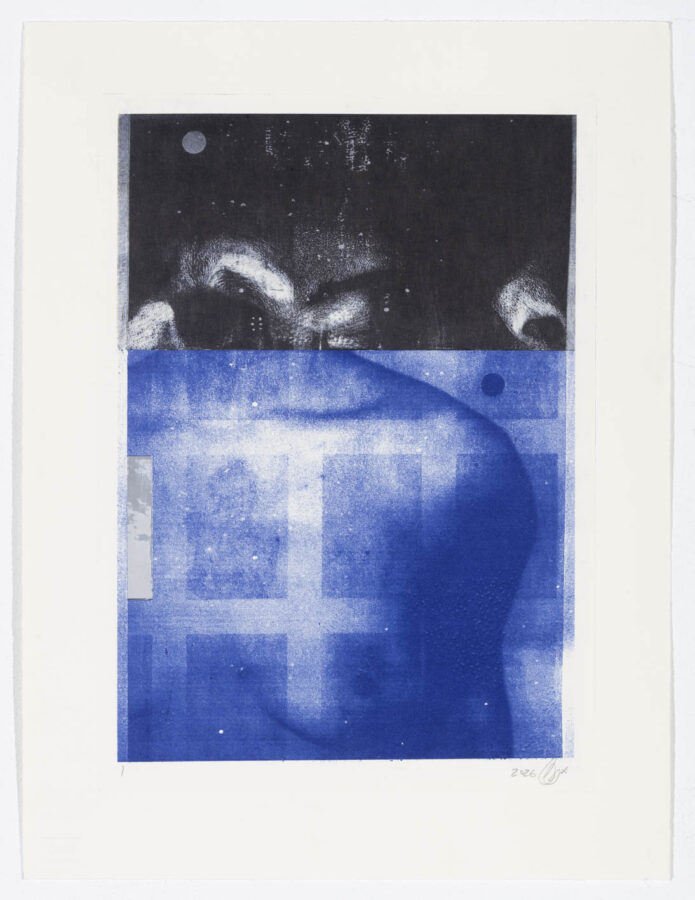
Turpin, 2026, I , Pronto lithograph, monotype with silver leaf and collage.
Rather than preserving each material in its intact state, Turpin cuts into them literally and conceptually. Collage becomes a method of thinking through memory and excess. What begins in abundant layers of imagery, typography, and colour, moves toward careful reduction. In that, a process of distillation is carried into the print studio. The use of cyanotype, with its deep Prussian blue and historic ties to early photographic processes, functions as a kind of timekeeper. It holds the image in a suspended state at once technical and atmospheric suggesting both blueprint and memory trace.
Working collaboratively in the David Krut Workshop, Turpin and Khulu navigated the nuances of exposure, tonal depth, and the absorbency of the paper to achieve a surface that feels simultaneously precise and soft. The addition of vinyl collage introduces a sharp, contemporary interruption an editorial gesture that cuts across the field of blue. This interplay between analogue process and clean-edged intervention reflects the work’s conceptual core: a negotiation between tactile print culture and the hyper-saturated digital present.
Minimalism here is not an aesthetic withdrawal but an act of focus. In a context where collage is often associated with dense figuration and overt narrative, Turpin pares back. What remains is fragmentary yet intentional an image distilled to its essential tension. The work resists spectacle and speed, inviting instead a slower encounter with surface, edge, and absence
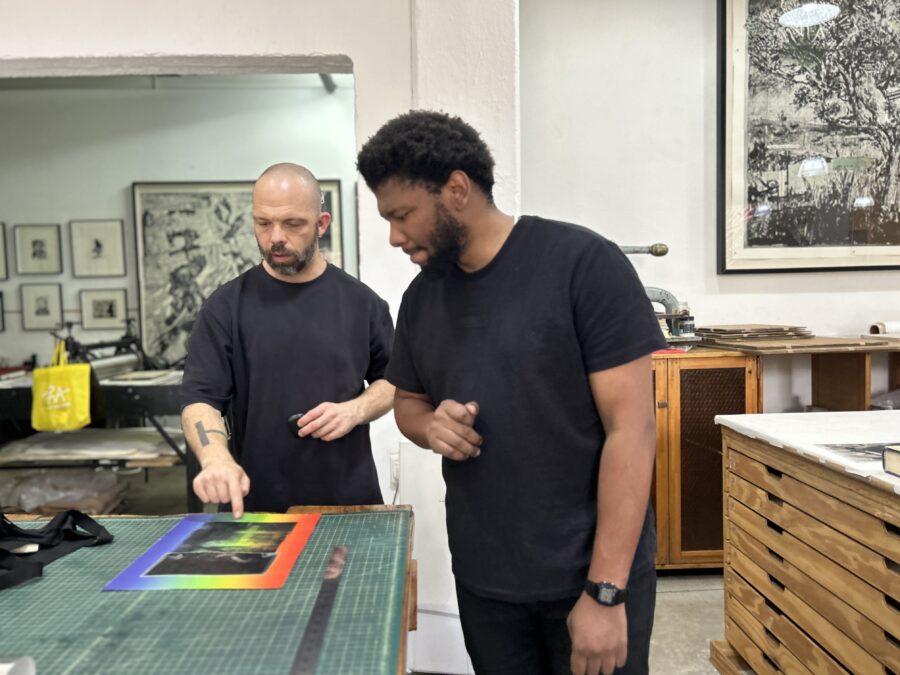
Turpin and Khulu discussing the rainbow roll monotype in relation to the lithographic image printed over it.
As a first collaboration with David Krut Projects, I, 2026 signals a new chapter in Turpin’s practice, expanding collage into the language of printmaking. It positions the workshop not as a site of reproduction, but as a space of translation and reinterpretation where archive becomes material, memory becomes surface, and the act of editing becomes a form of authorship. Presented at the Brooklyn Art Fair 2026, the work carries its inquiry into an international context, extending Turpin’s meditation on image, identity, and time beyond its point of origin.
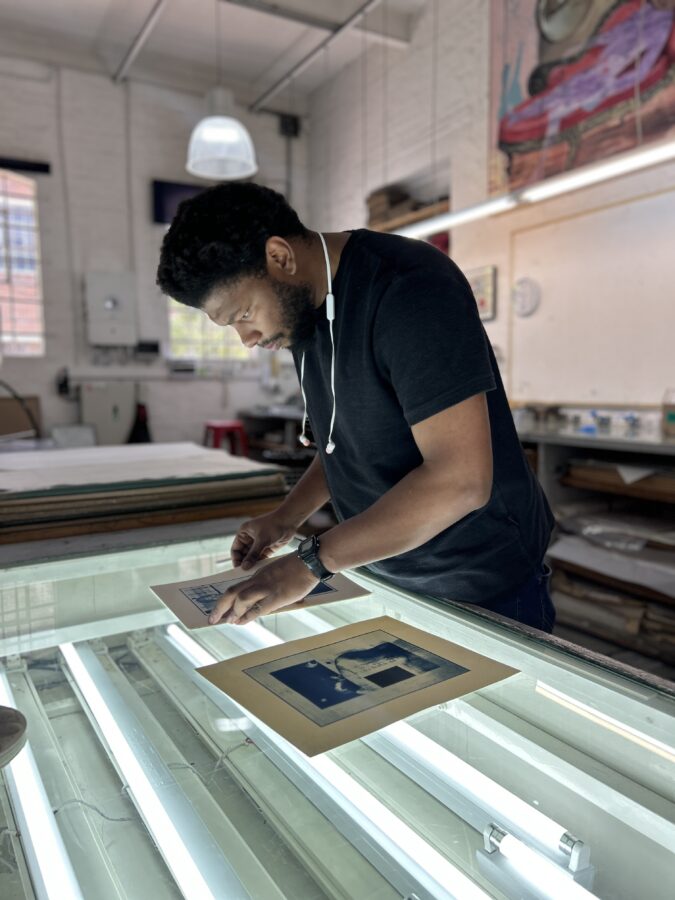
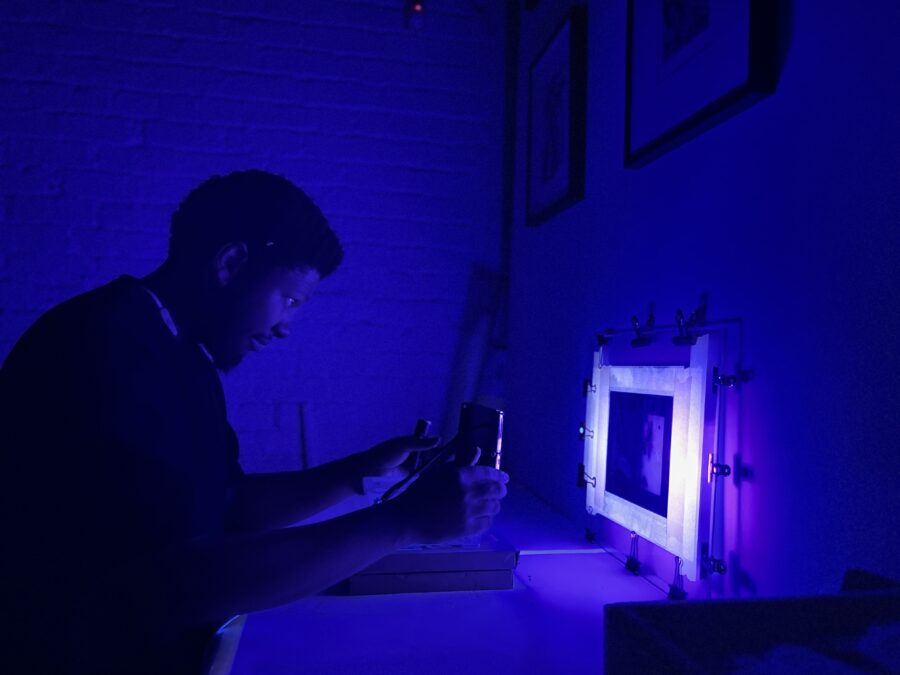
Khulu exposing a cyanotype print using a UV light.