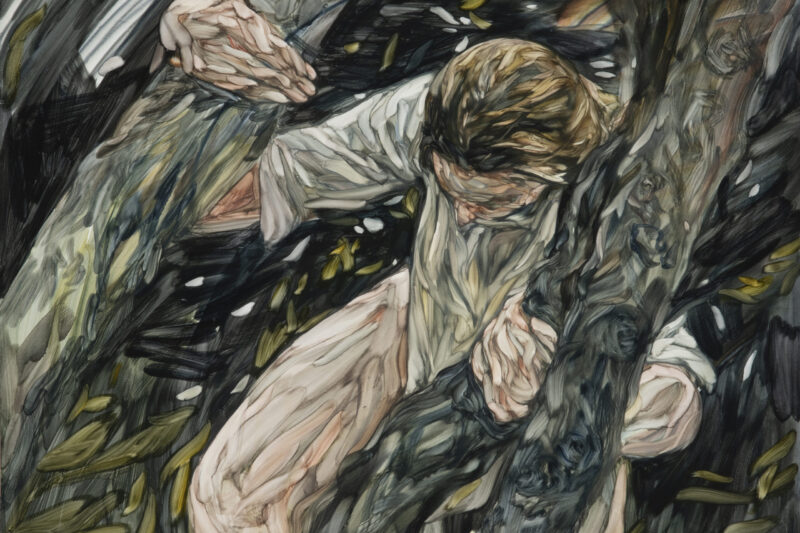
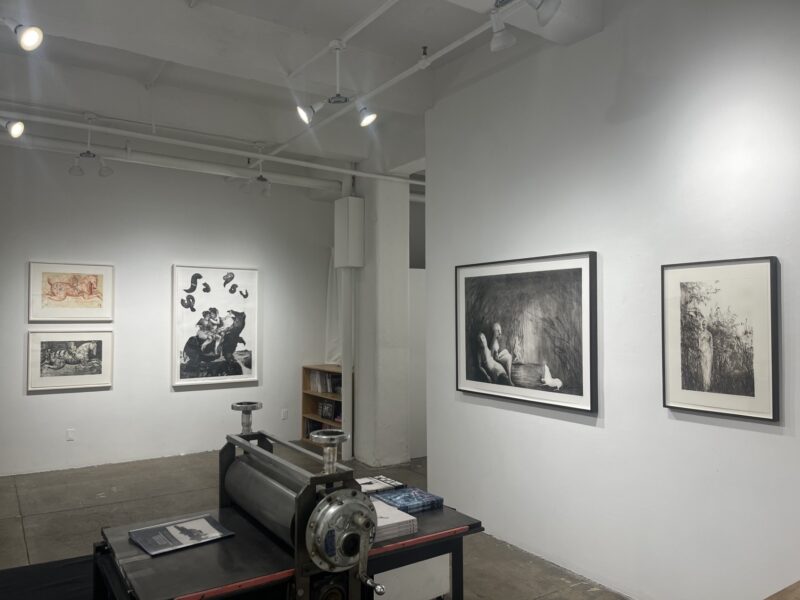
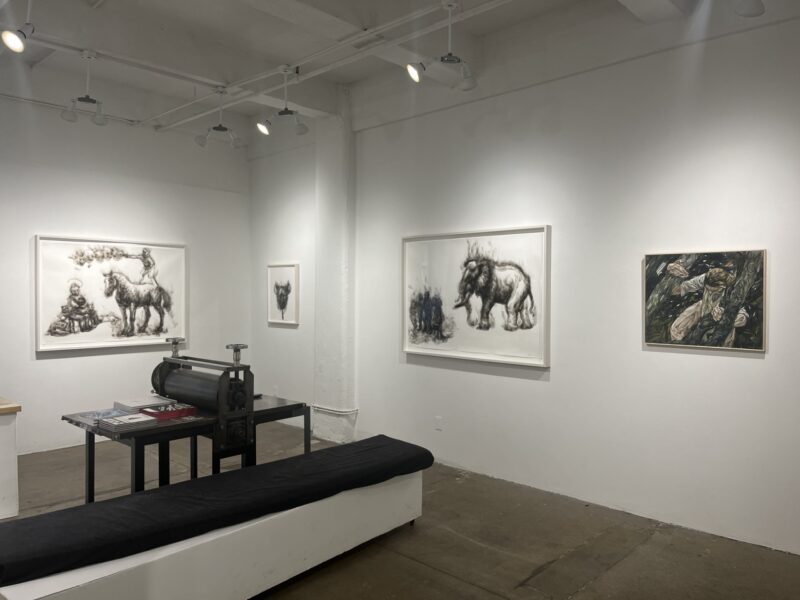
David Krut Projects Artspace, New York is pleased to present “The River Beneath the River: Women Artists and the Human Figure in Nature,” an exhibition of work created largely at David Krut Workshop (DKW). The included works locate spirituality in feminine connections with nature, depicting human figures in harmony with the natural environment.
Writer Clarissa Pinkola Estés discusses an inherently feminine connection to nature, one which allows us to connect with myths, fairy tales, and folklore of times gone by. This can be done by reaching a place between worlds, a “collective unconscious,” where “visitations, miracles, imaginations, inspirations, and healings” can occur (1): “Each woman has potential access to Río Abajo Río, this river beneath the river.” She arrives there through the “intense altered consciousness” brought on by creative work, and “much of what occurs in this ineffable world remains forever mysterious to us” (2).
A “river beneath a river” relates to the psychoanalytic practice of using a “stream of consciousness” to access the unconscious, and wider connections between femininity, the unconscious, and bodies of water. Among various cosmogonies, parallels exist between these ideas: “the sea is the favorite symbol for the unconscious, the mother of all that live” (3), and has been “considered a primal uterus, the source of all life” (4).
The artists in this exhibition also draw inspiration from (often ancient) cosmogonies, allowing their scenes to take on a mythological significance. Part of this is related to the allegorical, yet loosely feminine nature of the figures they depict, who seem to be free of specificity, instead uniting with and drawing strength from the flora and fauna around them. Discussing her etching Wolf Cave, Deborah Bell states: “The cave and the open expanse are about the inner and the outer, the womb and the world.” These artists look inwards, underscoring the value of a spiritual understanding that embraces the inevitable darkness, mystery, and depth of nature and of the human experience.
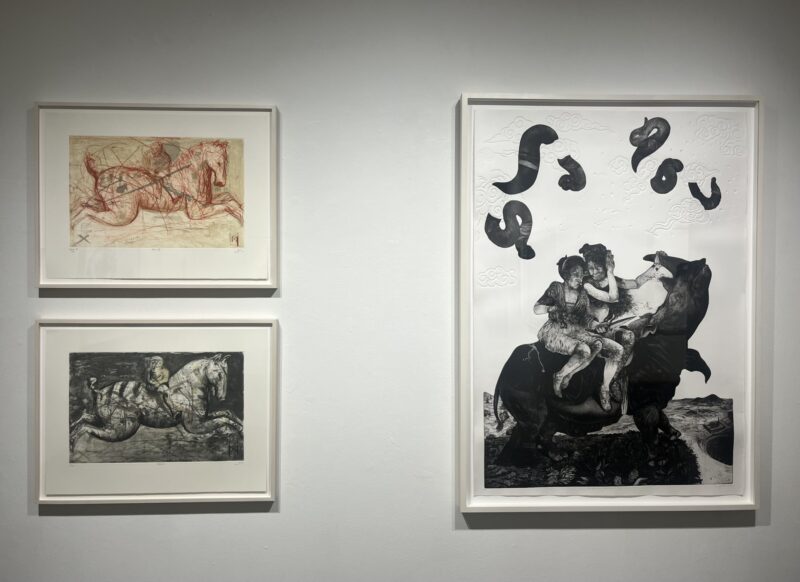
Artists such as Bell and Nthabiseng Kekana aim to act as conduits for these ideas, depicting a communion between humans and nature that goes beyond the visual. Diane Victor’s work often depicts interactions between human and animal figures, sometimes playfully and other times with a stunning gravity. Heidi Fourie’s gestural compositions illustrate spiritually compelling human interactions with nature, where figures often seem to dissolve into their surroundings.
These works tap into natural desires to forge connections with nature and to have faith in its power. Each in their own way, these artists take a distinctly feminine perspective that works to unify through spiritual understanding. “The River Beneath the River: Women Artists and the Human Figure in Nature” brings together depictions of a spiritual quest, aiming not towards objective knowledge, but towards deeper communion with one’s surroundings.
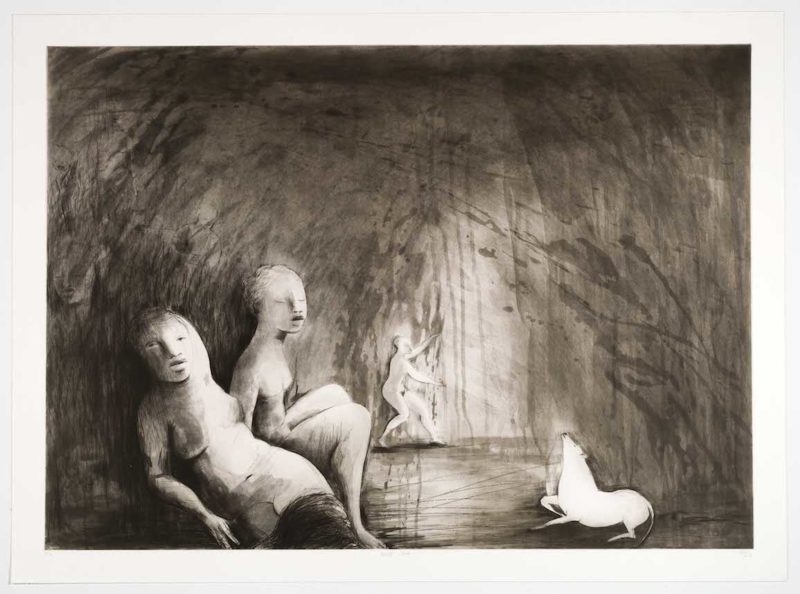
Diane Victor (b. 1964, Witbank) works in drawing and printmaking, and her work generates a palpable tension that arises not only from her biting social commentary and the sometimes macabre nature of her images and narratives, but from an interplay between the tough and the fragile, the hard edges of her visual narratives and the delicate mark-making and fragility of her preferred media.
Victor received her BA Fine Arts Degree from the University of the Witwatersrand in Johannesburg with a major in Printmaking. In addition to graduating with distinction and winning various awards, Victor also became the youngest recipient of the prestigious Volkskas Atelier Award in 1988, which granted Victor a ten-month stay at the Cité International des Artes in Paris. Since 1990, Victor has been a part-time lecturer, teaching drawing and printmaking, at various South African institutions including the University of Pretoria, Wits Technikon, Pretoria Technikon, Open Window Academy, Vaal Triangle Technikon, the University of the Witwatersrand, Rhodes University and the University of Johannesburg. In May 2025, Victor received an honorary doctorate from the University of Pretoria’s Faculty of Humanities. Her work resides in public collections including that of the Metropolitan Museum of Art, Museum of Modern Art (MoMA), Smithsonian Institution, Bibliothèque Nationale de France, Fondation Blachère de France, Iziko South African National Gallery, Johannesburg Art Gallery, and Pretoria Art Museum.
Deborah Bell (b. 1957) is a leading painter, sculptor and printmaker in South Africa. In her work across different media she is concerned with worlds in between: the realm between “mortality and immortality, matter and spirit, presence and absence, the quotidian and the mythic, the grounded and transcendent.” Bell has noted of her practice: “The idea of an artist as a magician delights me. It is about alchemy and the turning of base material into gold.” Bell’s work is fundamentally informed by a personal search for the ‘Self’ and she often draws on spiritual imagery from a wide range of sources. Multi-layered references and connection to ancient sources and memories are linked to her spiritual beliefs and how she defines herself as an artist in Africa. The continuity of form and content within Bell’s oeuvre allows for interpretation of her work to reach beyond the personal search of the artist herself.
Deborah Bell’s series of collaborations with David Krut began in 2000 when he introduced her to Jack Shirreff and his 107 Workshop in Wiltshire, United Kingdom, where Krut had been collaborating with accomplished international artists since 1981. Bell’s collaborations with artists Robert Hodgins and William Kentridge on different projects in a range of media and themes play a central role in her early work, and the unique relationships forged with these collaborations had further significant influence on the individual works of each artist to follow. She is the winner of multiple awards and her works lie in numerous private and public collections, including the Johannesburg Art Gallery, Museum of Modern Art (MoMA), National Gallery of Art, and Smithsonian Institution.
Nthabiseng Boledi Kekana (b. 1999, Johannesburg) is a contemporary South African painter. Her work explores femininity and spirituality, and is rooted in a profound connection to her heritage. Using emotions and spirituality as her guide, Kekana examines otherworldly ideas. She works in a range of mediums, including oil, charcoal, pastels and natural fibres, to express the fluidity of creation.
Kekana obtained a degree in Three-Dimensional Design from the National School of the Arts, and a subsequent advanced degree in Digital Media in Design (Multimedia) from the University of Johannesburg. In late 2023 David Krut, while in London, visited an exhibition titled Dualities by Undiscovered Canvas at the Bernard Jacobson Gallery in Mayfair. Kekana’s work stood out to him, and he immediately planned to see if she would be available to spend time in the workshop making a body of prints. In March 2024, she spent a week collaborating with Printer Roxy Kaczmarek at the David Krut Workshop (DKW) in Johannesburg. Her first foray in printmaking has produced an accomplished body of unique painterly prints – monotypes and a pair of large etchings.
Kekana was one of the four shortlisted finalists for the 2021 Cassirer Welz Award by Bag Factory Artists’ Studios, in partnership with Strauss & Co Fine Art Auctioneers, and she placed Top 6 for the Blessing Ngobeni Art Prize 2022. Her work resides in numerous private collections, particularly in Europe, Africa, and North America.
Heidi Fourie (b. 1990) uses oil painting and monotypes to explore the relationship between people and the spaces they occupy. She takes inspiration from the medium’s natural tendency to represent organic lines and shapes. Curiosity motivates her practice, as demonstrated by her gestural representation, muted palette, and unique angular perspective. By emphasizing organic qualities in the natural world through washed texture and depth, Fourie explores intuition and relativity. Fourie studies how the results of figurative representation and the intrinsic qualities of paint are pursued simultaneously. Her subject matter is simple – everyday scenes of figures and familiar objects – and this simplicity frees her to practice and constantly refine her balancing act between restraint and excess, between gestural and polished mark-making.
She completed her Bachelor of Fine Arts, majoring in painting, in 2012 at the University of Pretoria, for which she received the Bettie Cilliers Barnard Bursary for Fine Arts. Her first solo exhibition, Islands, was produced under the mentorship of Frikkie Eksteen and presented in 2015 at Lizamore & Associates Gallery in Johannesburg. Since then, she has had multiple solo exhibitions, and she has been shown in group exhibitions countrywide. Fourie has been collaborating with David Krut Workshop (DKW) since 2017, when she first visited to create a series of watercolour monotypes. At the beginning of 2023, Fourie once again collaborated with DKW to create a series of monotypes that were shown at the 2023 Latitudes Art fair. Fourie’s work was also shown in the DKP booth at the 2024 Latitudes art fair, and she was also one of the featured artists of the fair. In 2019 she became a fellow of the Ampersand Foundation which resulted in a month-long residency in New York. Fourie’s works reside in many private collections, and she lives and works in Pretoria.
- Clarissa Pinkola Estés, “The Howl: Resurrection of the Wild Woman,” in Women Who Run With the Wolves: Myths and Stories of the Wild Woman Archetype (New York, New York: Ballantine Books, 1992), 29.
- Estés 30.
- Carl Jung, quoted in Jane Caputi, “Jaws as Patriarchal Myth,” essay, in Goddesses and Monsters: Women, Myth, Power, and Popular Culture (Madison, Wisconsin: University of Wisconsin Press, 2004), 35.
- Caputi 27.