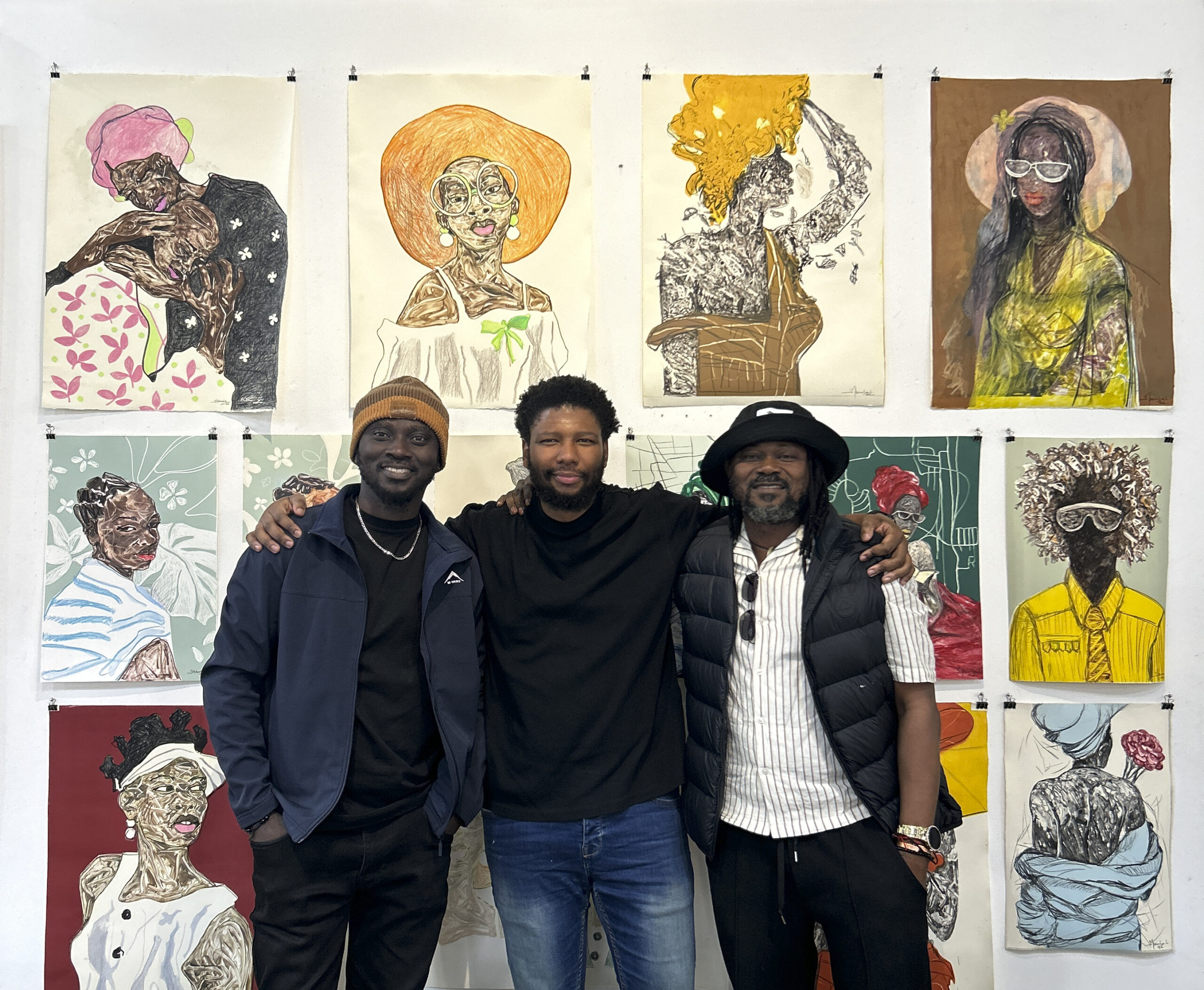
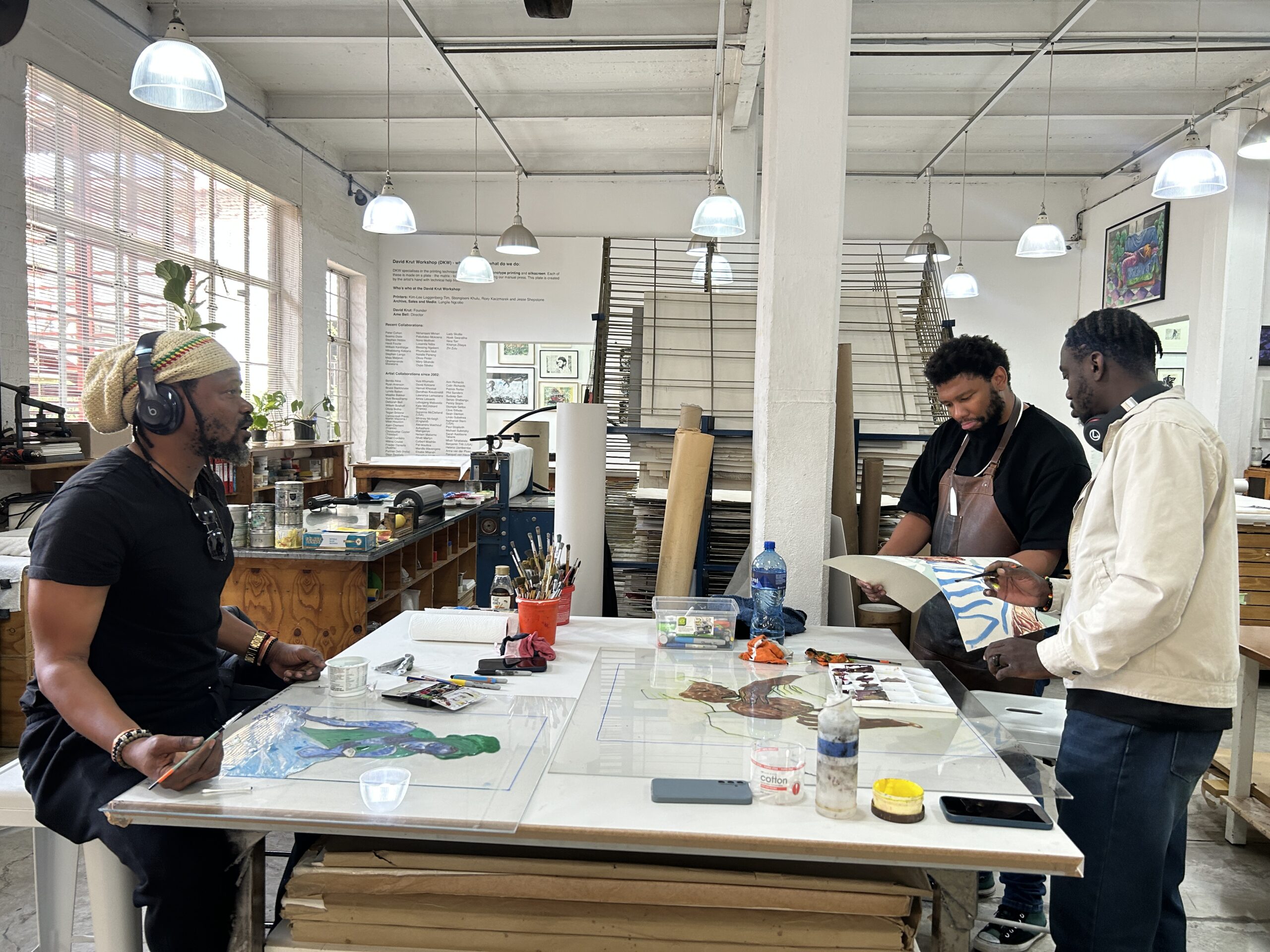
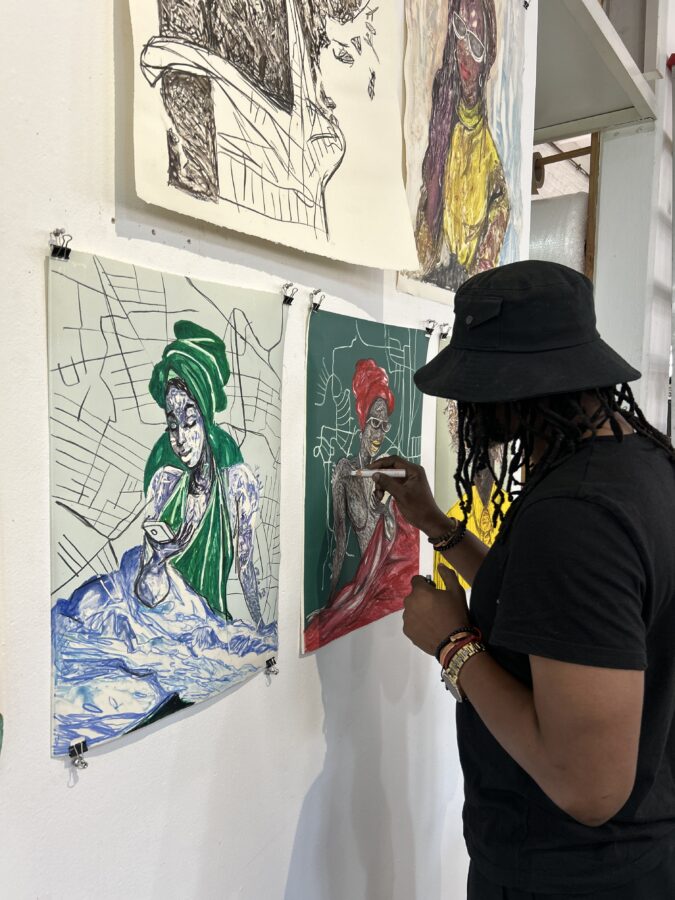
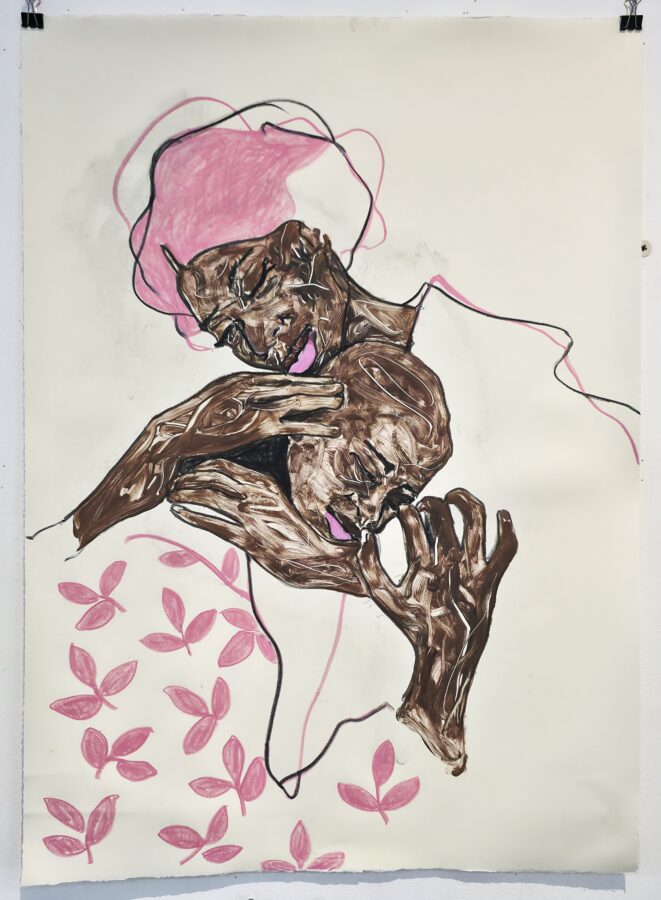
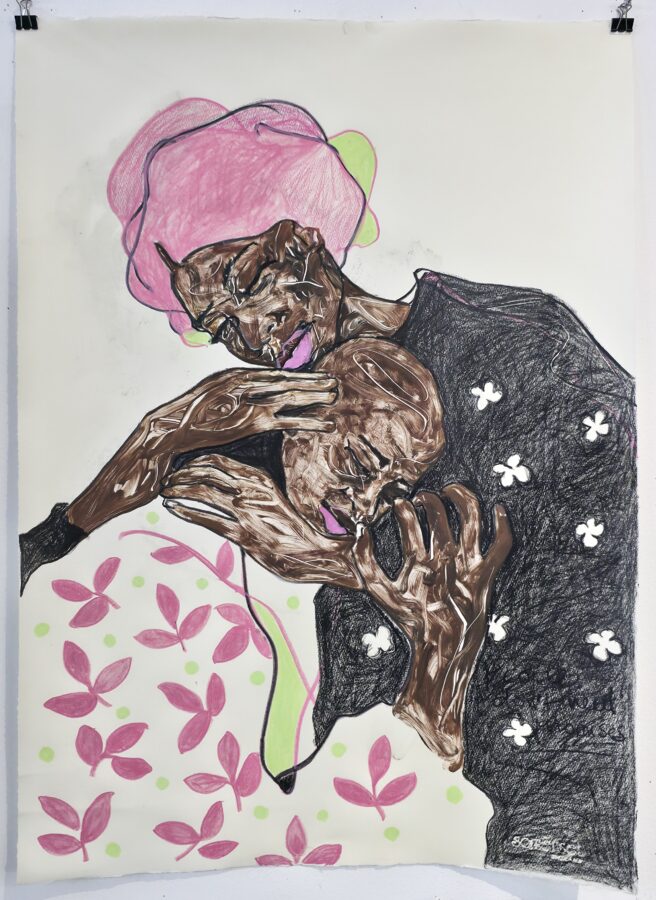
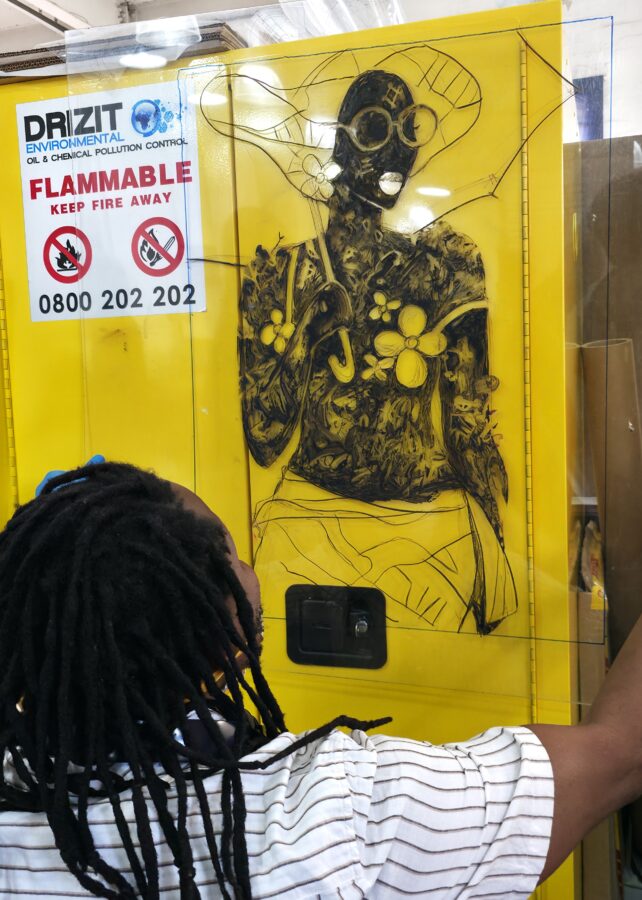
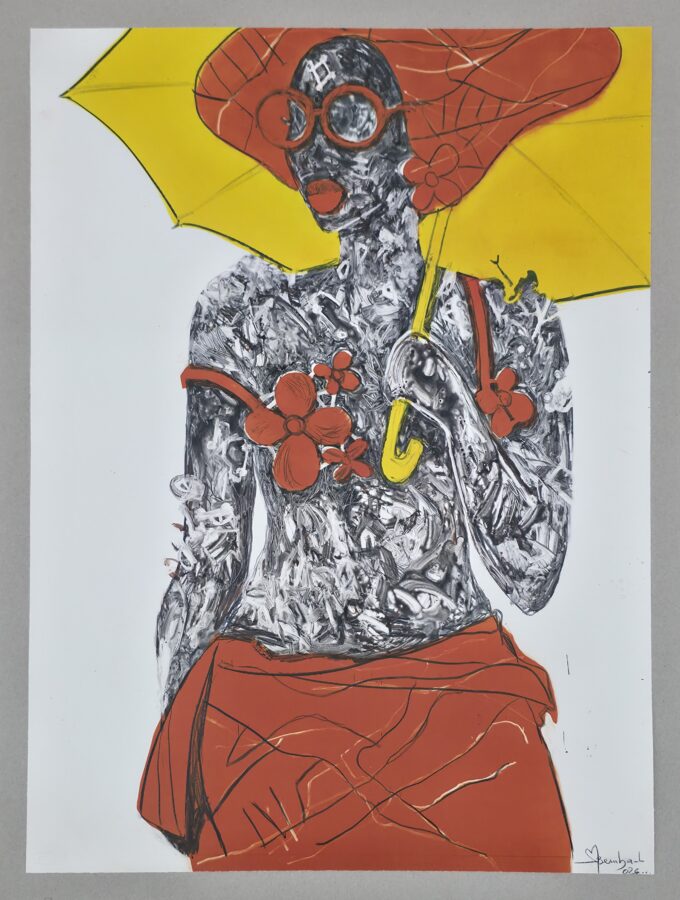
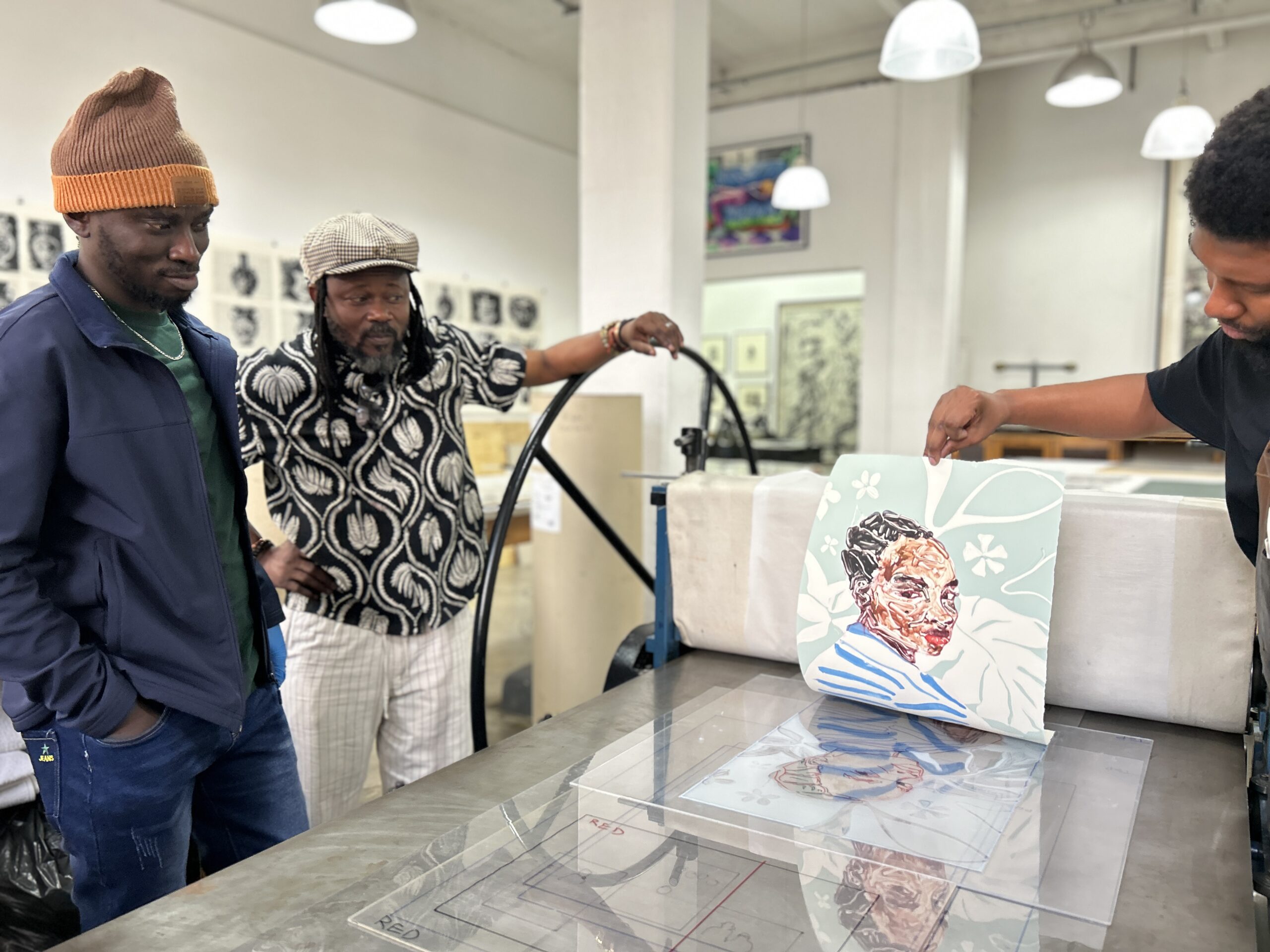
(Left) Sisqo Ndombe, (middle) Sbongiseni Khulu and Doudou Mbembe (right). Photograph by Lungile Ngcobo at David Krut Workshop
David Krut, in conversation with neighbouring booth presenter Yvon Edoumou of Gallery Malabo, invited two artists visiting the 19th FNB Joburg Art Fair from Kinshasa, Democratic Republic of Congo to a creative experience at David Krut Workshop. Doudou Mbemba and Sisqo Ndombe, neither experienced in printmaking, have been able to create new artworks at DKW a studio known for Krut’s generosity and the support skills of a team of four very experienced master collaborators, besides being artists themselves, at Arts On Main in Joburg’s downtown Maboneng art precinct.
The Workshop, part of David Krut Projects was the pioneering art making activity at Arts On Main, followed with the completion of William Kentridge’s major sculpture studio. Artists and other makers have had studios there and is now the location for the famous William Kentridge’s multi-dimensional Centre for the Less Good Idea.
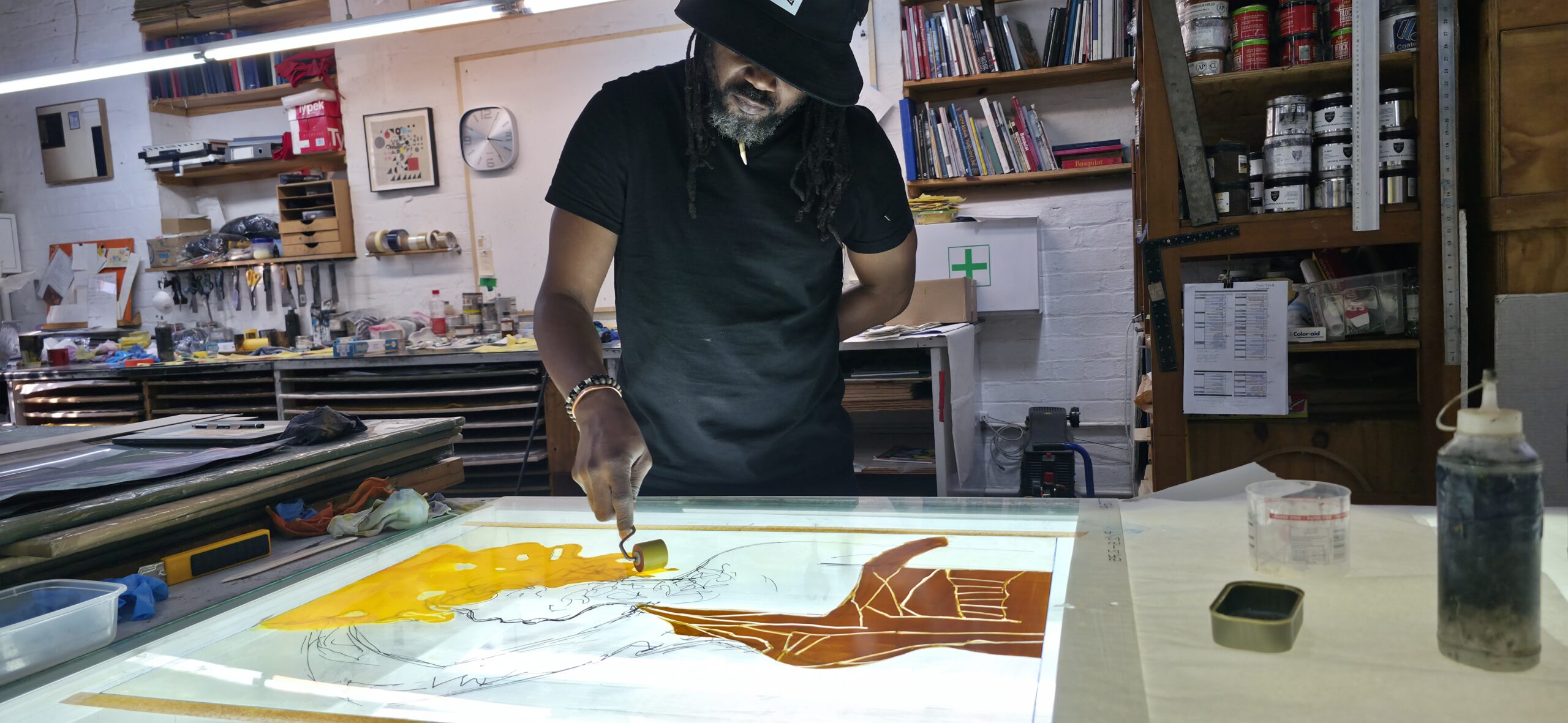
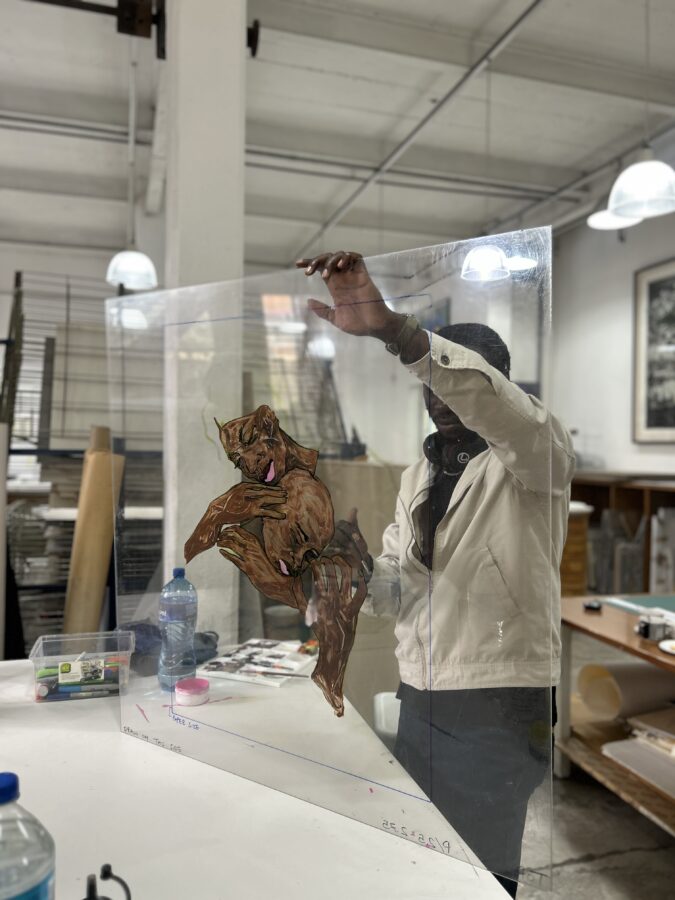
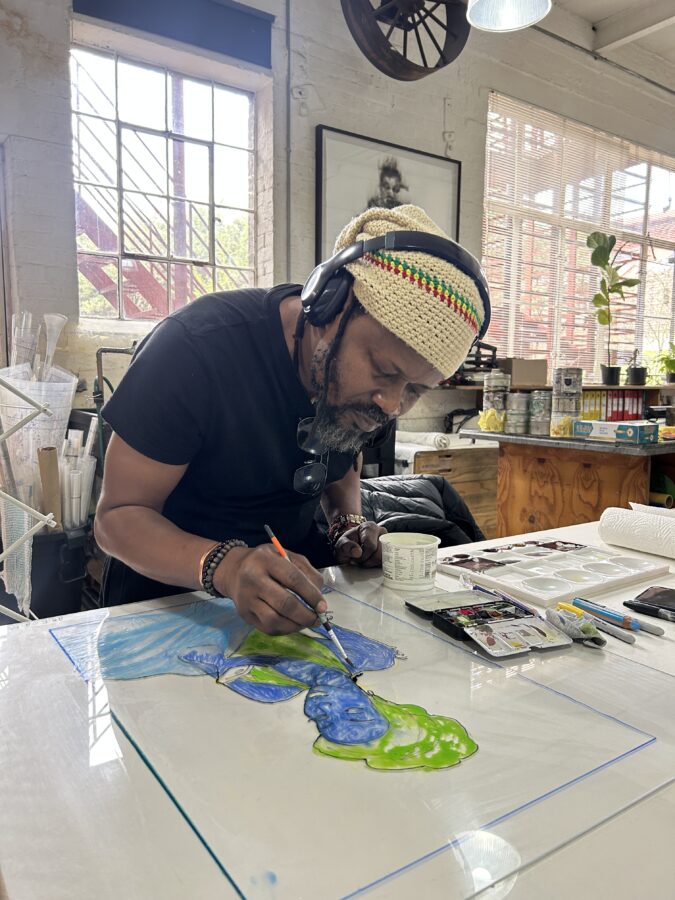
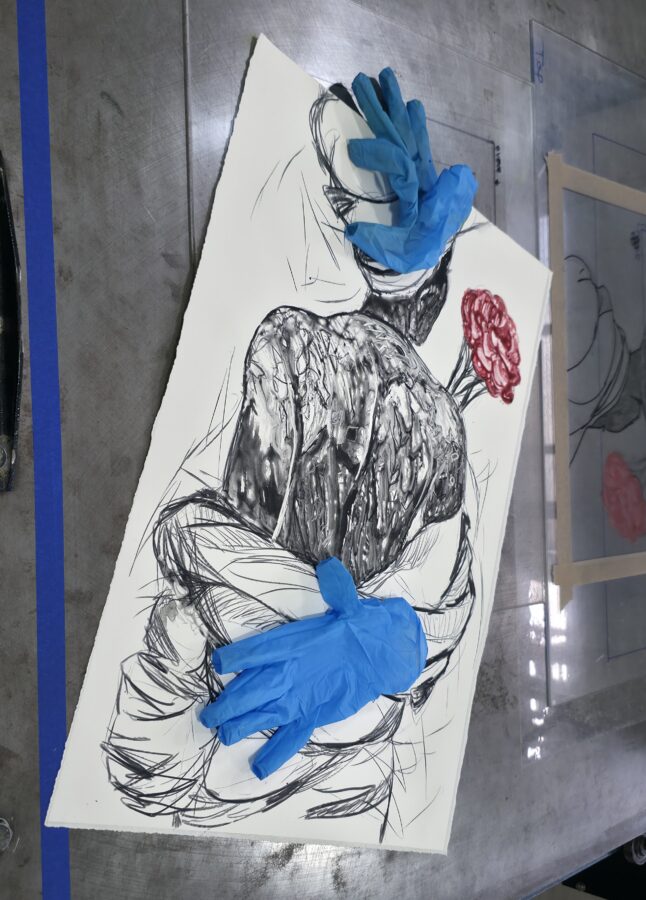
The two artists stayed for a week after the Art Fair allowing the creating of work in collaboration with Sbongiseni Khulu. The works were created in a medium known as monotype, a printmaking technique which allows the making of unique single impression of a paintings made on a planar surface, and then transferred in reverse by passing under the roller of a heavy etching press, onto archival fine art paper.
The interactive conversations were unusual as the artists spoke no English which meant a collaboration through visual observation and direct physicality. The shared passion of making in the Workshop provided an excitement for the making of very accomplished art works – five days each by Sisqo Ndombe and Doudou Mbembe, creating six resolved works referencing their familiar imagery in a medium which combined oil-based and watercolour monotype with direct handwork
Doudou Mbemba
Born in Boma in the Kongo Central province in 1978, Doudou Mbemba is based in Kinshasa studied painting at the Institut des Beaux-Arts in Kinshasa before continuing his studies at the Académie des Beaux-Arts de Kinshasa, where he graduated with a bachelor's degree in visual arts specialising in painting.
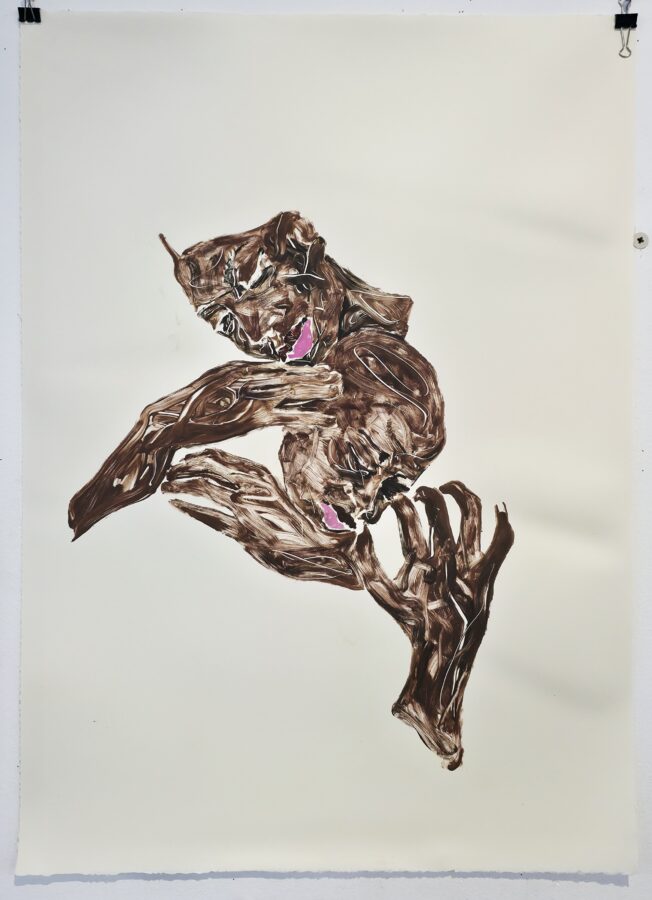
During his studies, he came to the attention of renowned Congolese artist Roger Botembe and subsequently worked at the Botembe Studios alongside other prominent contemporary Congolese painters. Mbemba’s practice engages with social disorder, conflict and the tensions created by individualism. His work uses vibrant colour and recurring imagery of traffic jams as a way of reflecting on a society in which collective interests can be displaced by individual concerns. His artistic philosophy is centred on the possibility of a more coordinated and participatory form of coexistence
Sisqo "Lenoir" Ndombe
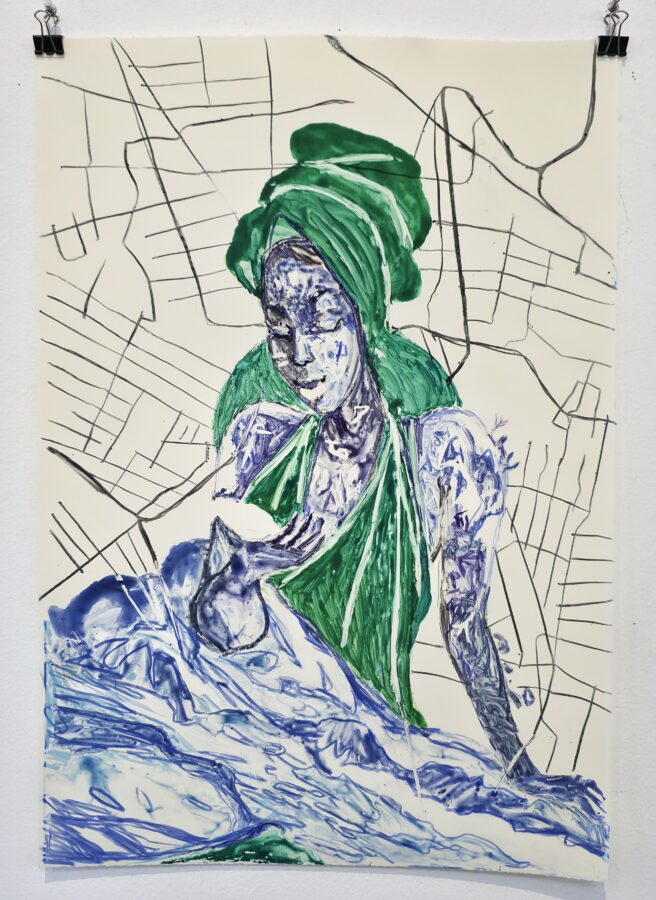
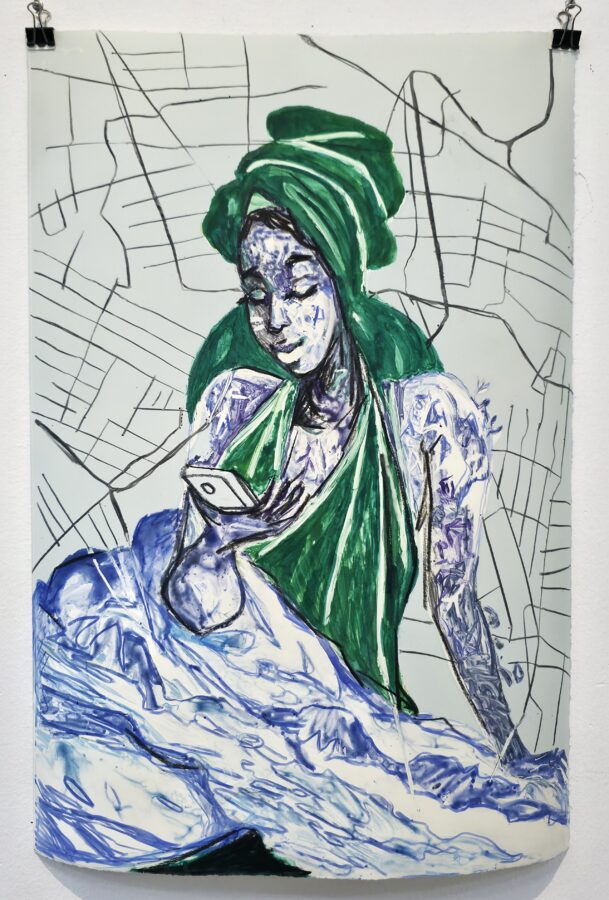
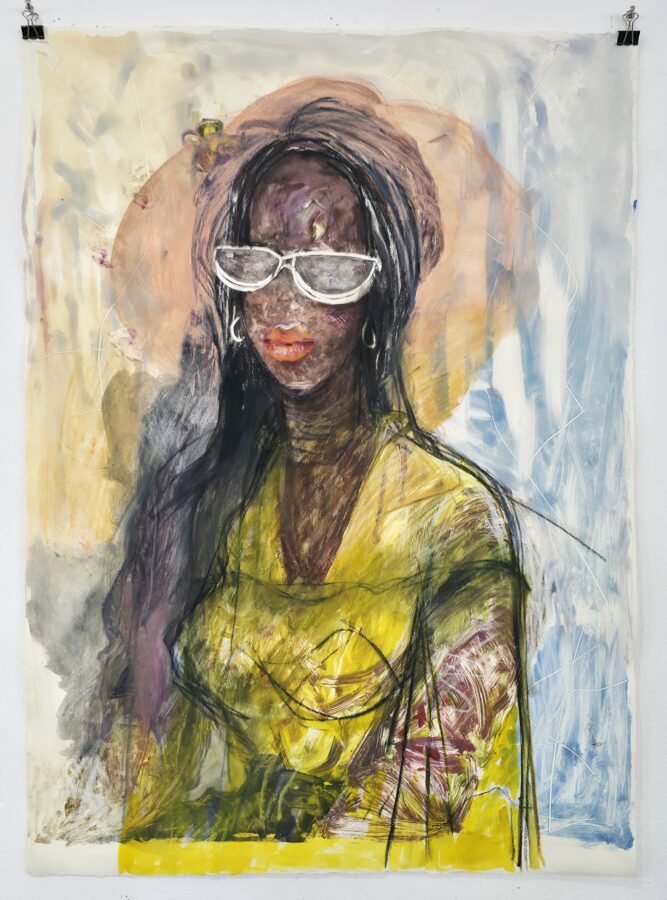
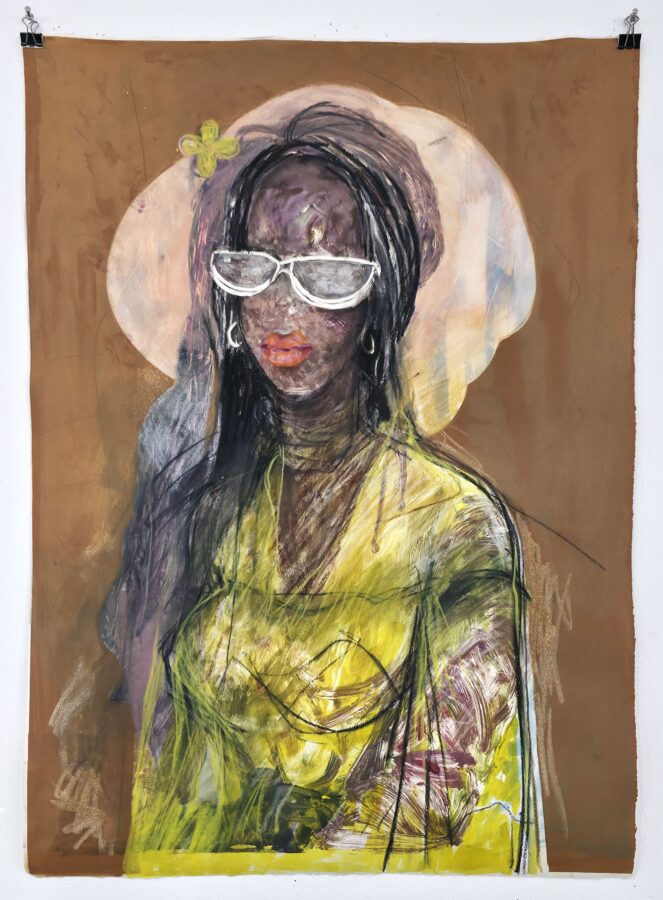
Born in Kikwit in 1985 Sisqo Ndombe Akisieful, known as Lenoir, is based in Kinshasa. He graduated from the Academy of Fine Arts in Kinshasa in 2008 and has since devoted his practice to portrait painting. His expressive portraits are distinguished by the intensity of their gazes and by his distinctive technique of painting directly with his fingers, creating networks of cracks across the surfaces of faces.
These fissures are described as embodying inner tensions while also connecting the individual figure to wider contemporary African social realities. His work explores human, social and political conditions, balancing fragility and strength, with wounds becoming spaces through which memory, resistance and hope can be projected.
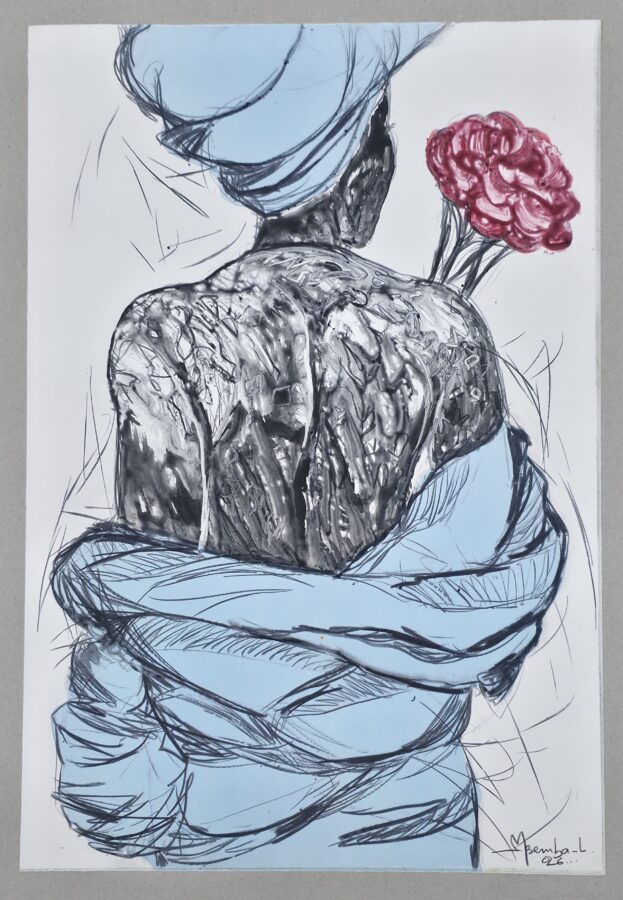
Sisqo’s series of six mixed-media monotype paintings are titled BEYOND THE GAZE. SPEECHLESS, SPEECHLESS 2, OBSERVER, CRACKED PEOPLE and UNSEEN SCARS, ranging from 55.7 × 38 cm to 74.5 × 55 cm on Somerset white archival paper.
Mbemba’s series of six mixed-media monotype paintings are titled MR KIVU, OU ES TU? LA DETENTE, MABONENG NEWS, FOULART JAUNE, PREMIER JOUR and JOLIE JAUNE, ranging from 55.7 × 38 cm to 74.5 × 55 cm on Somerset white archival paper.
A week of experimentation
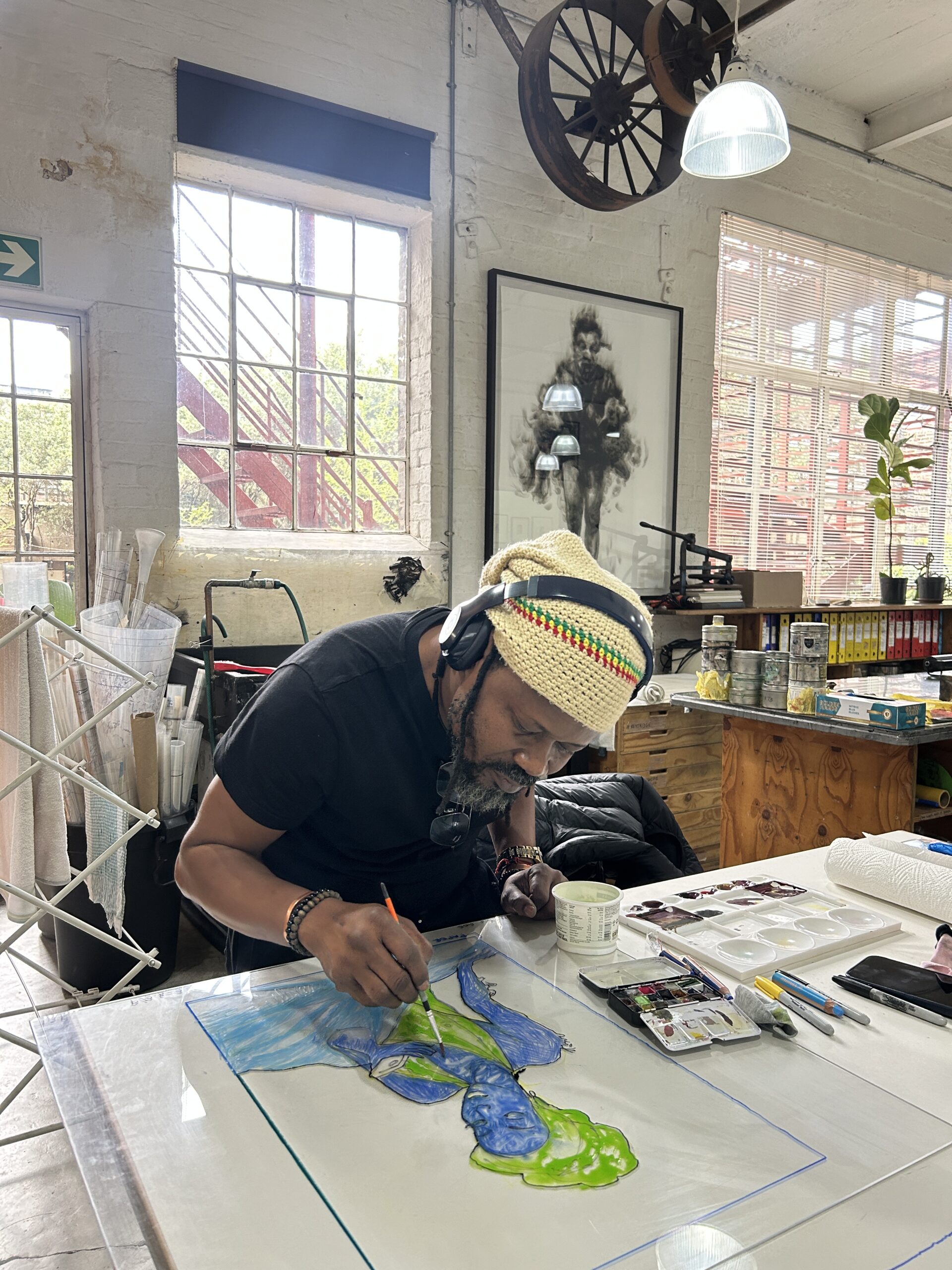
The workshop became a space of exchange between artist, printer, material and process. Working alongside Sbongiseni Khulu, Doudou and Sisqo were able to test how their established painting practices can shift when translated into the immediacy and unpredictability of a reversed monotype image.
For both artists, the week became an opportunity to investigate monotype as an open, experimental and controlled form of art making. As a one-off direct transfer process, the medium allows for a very particularly response on the paper: every mark, layer and transfer contributes to the unique painted image.
The process began with oil-based monotype, using the printing plate as a surface for drawing, painting and mark-making before transferring the image onto paper. Oil-based ink allowed the artists to work with rich marks and varied textures, while the printing process itself introduced elements of unpredictability.
The artist also incorporated watercolour, creating a contrast between the properties of the two mediums. The transparency and fluidity of watercolour introduced another way of building an image, while the oil-based process offered denser marks and more defined gestures.
In some of the works, the artists moved beyond the plate and introduced direct handwork expanding the printed imagery after it had been transferred onto paper. This combination of print and hand-applied marks blurred the boundary between printmaking, drawing and painting.
One of the most interesting aspects of the week was watching the images change from one impression to the next. A mark made during one stage could become the foundation for another layer; an existing image could be partially obscured; and new forms could emerge through the accumulation of colour and gesture.
The multiple processes which the arts employed highlights one of the distinctive qualities of monotype: the possibility of responding to the unexpected. Because each print comes out in reverse, and being unique, it allows the artists to make decisions based on what was already on the paper rather than working towards identical impressions.
The workshop therefore became a space not only for producing pigmented images, but for testing ideas through the physical processes of using a press in printmaking. Ink, watercolour, pressure, paper, movement and handwork all became part of the conversation.
With the creation of multiple layering of each print the artist’s making time in the workshopbecame reduced, a limitationthat presented them with a choice, to either continue exploring more mediums in printmaking or firmly cement themselves within themultiple capacity of themonotype technique as an extension of their individual artistic practices.Both Ndombe and Mbemba pushed to see how manyvaryingcolour layers of their respective monotype prints could be held before the paper became fully suffused with ink and paint.