By Chloé Truscott
THE INVITATION
To be honest, when I heard that David, Amé and Sbongiseni (members of team David Krut) were on their way to have ‘The Iris’ – one of Kentridge’s early 90s works – for signature at his home studio, I positively longed to accompany them…
I think my longing must have shown on my face because, just as they were leaving, David asked if I felt like going for a ride to visit William Kentridge? I tried my best to sound casual, “That would be lovely“.
David’s tiny white Fiat sped along the quiet streets – no traffic courtesy of a local protest – and soon we were traversing up a narrow, stone flagged footpath. The steep incline made it feel like we were climbing up to a mountain dwelling, one reinforced with red brick and steel.
THE STUDIO
We emerged into Kentridge’s studio through a doorway leading from the front room of the building. It had a high ceiling, and walls were covered with different projects. It beckoned for a closer inspection ... yet it felt like an intrusion to cross this threshold.
THE ART
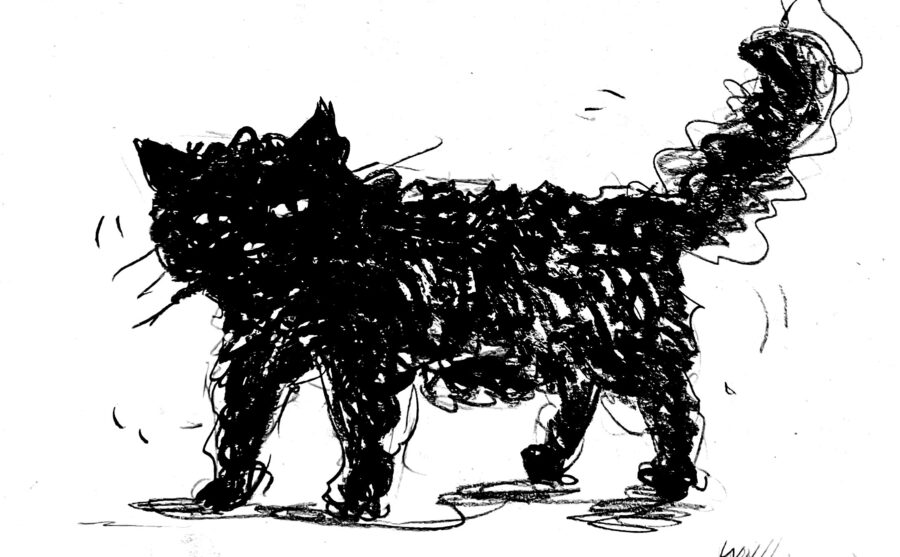
There was so much to look at: sculptures, gilded objects – some hand-made, some natural. Massive charcoal drawings, some of which are the working frames for another film that William is busy creating – a cheeky cat, a street scene brimming with people and buildings.
High up against a wall, a miniature version of an opera production was hanging as if suspended in time.
THE FILM
William led us to his film-making studio where Josh the Film Guy was busy editing at one of the large computer screens in the dimly lit, half-circle room. I felt amazed and honoured when William asked if we’d like to see his work in progress …
We all arranged ourselves to watch.
As soon as the footage started, my gaze was fixed and I saw the drawings from the big room downstairs. They somehow came alive now and I was transported into a world where charcoal has been given life, it is full of rawness and grit; a haunting journey. The cat could see us, I’m sure, as he sassily danced. He transfigured then returned—looking mischievous.
A century seems to play out before your eyes on paper: a silent explosion rocks the room. A building is rapidly overgrown, turning into a forest in seconds. And then abruptly, the screen goes dark. The sound-engineering panel comes up. And the work is continued.
THE TRIVIA
William asks me where I‘m from. “Harrismith” I answer, adding “yes, it is more than a mountain and a garage”. William nods with a slight smile, “My great grandfather is buried in Harrismith’s old cemetery.“
THE GARDEN
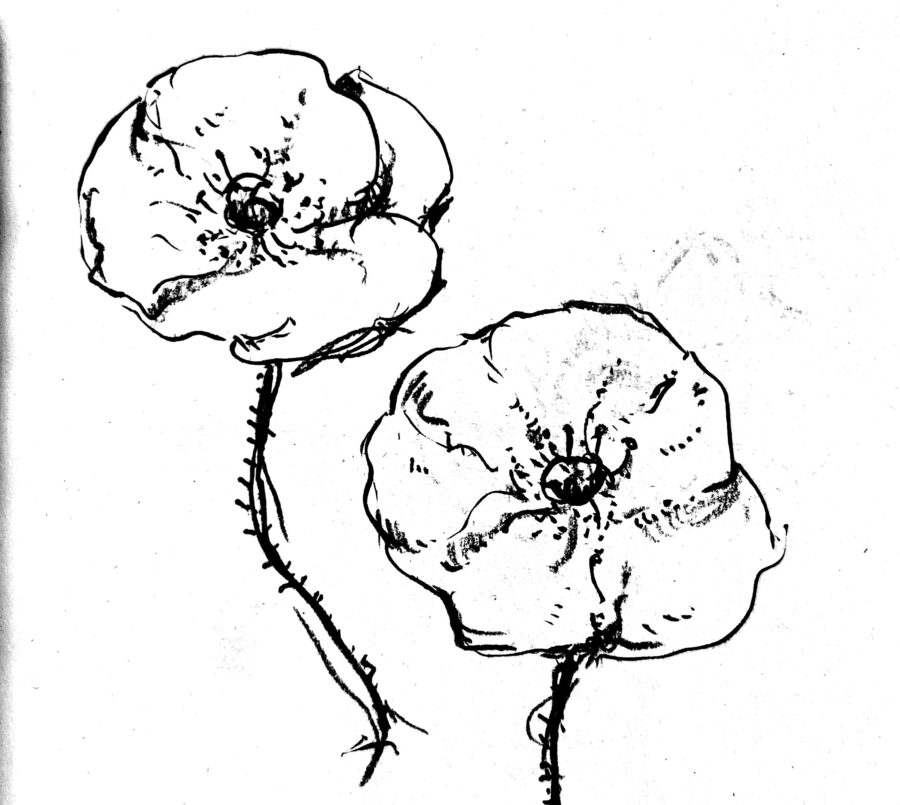
William’s garden is a live portrait of blooms. Among them are vivid Californian poppies and a large, buttermilk coloured rosebush. It somehow feels like late summer, even though it is June, and there are fallen leaves strewn across the grass. The garden overflows with lush trees and shrubs. The different tiers of lawn give the feeling of being in a palace garden.
The house in which William grew up is tall, painted white and has the artist’s fingerprints all over it. Subtle, private, and beautiful. A sanctuary…
What this special and spontaneous visit revealed to me, as I looked at the artist’s works in progress, the experimenting, glimpses of the visions by a living legend, was that art is work.
And that geniuses are also human; that making is both a struggle and a joy; that it takes a lot out of you, but that it gives so much back. The return of investment in time and effort it takes to make something beautiful, or a little scary or devastating, is an investment that can reach far and wide and touch so many minds and hearts. Be it the attitude of a scruffy charcoal cat with its penetrating eyes, a building ripped to shreds by an explosion, or by a garden cared for and loved.