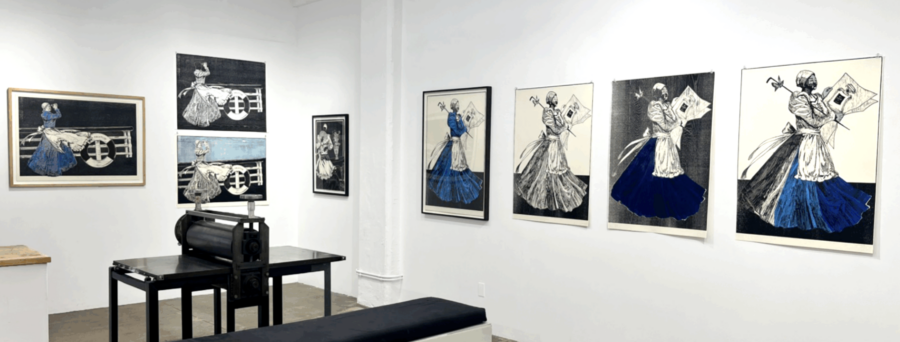
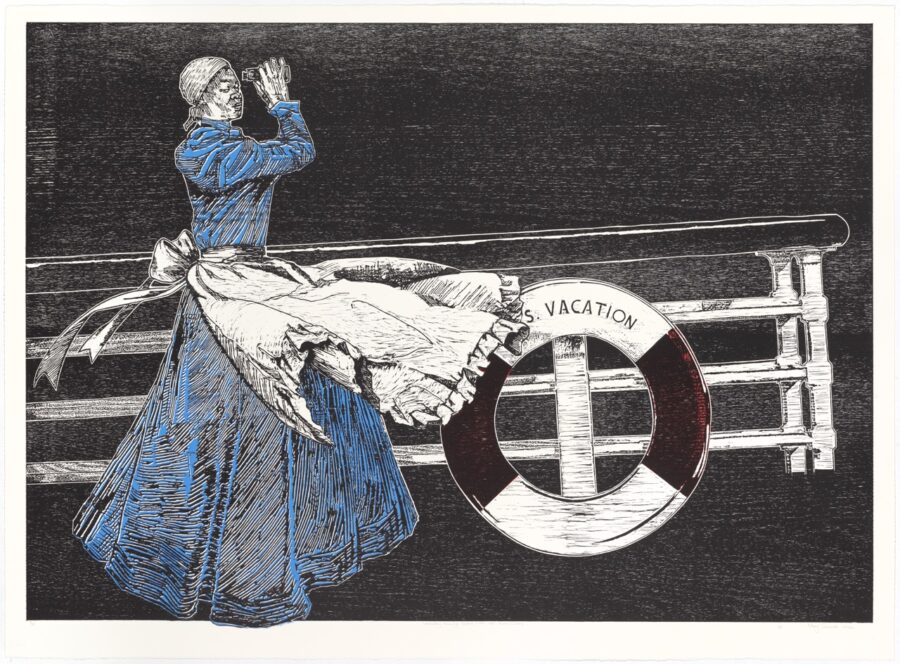
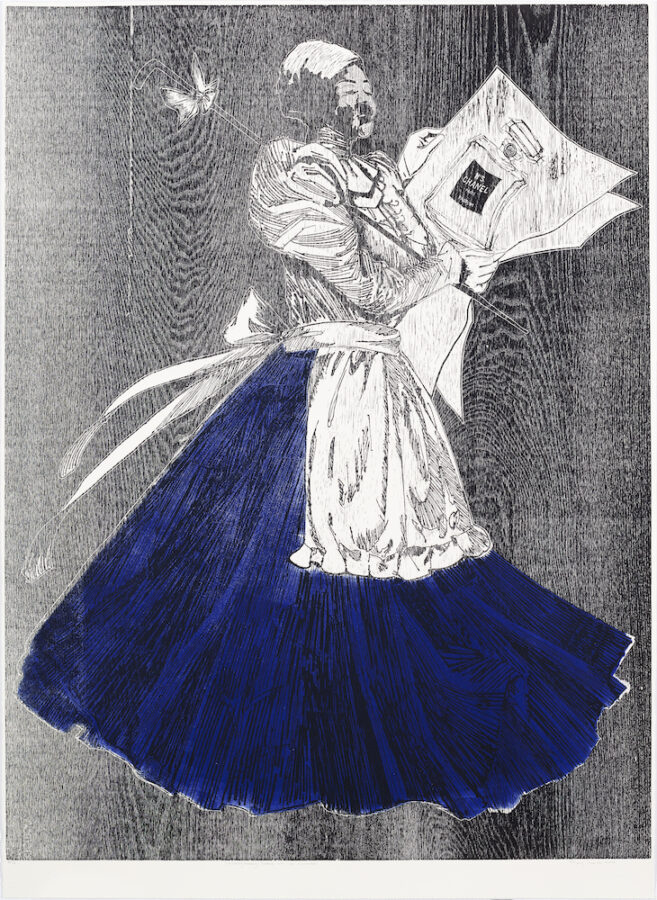
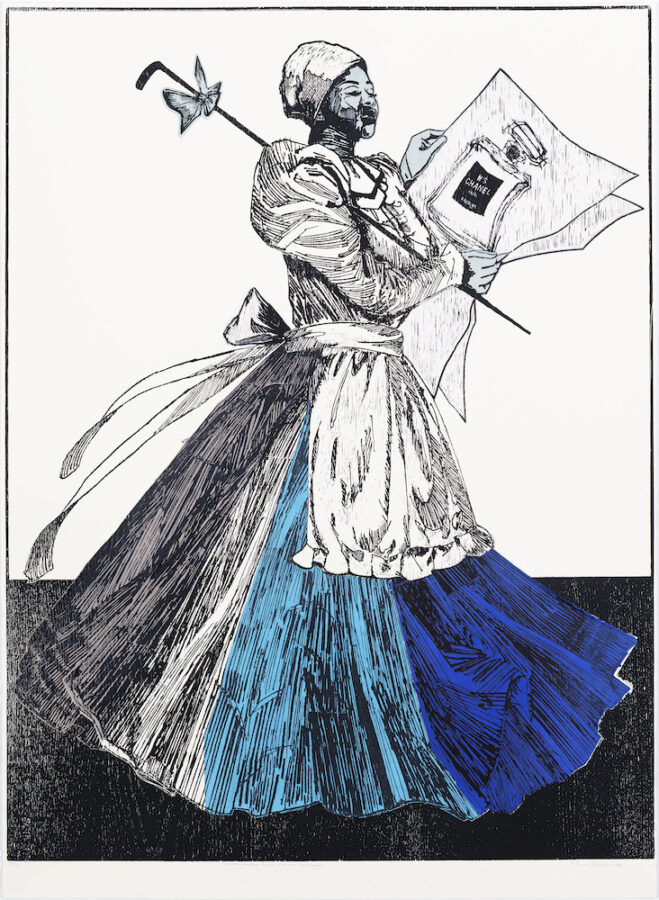
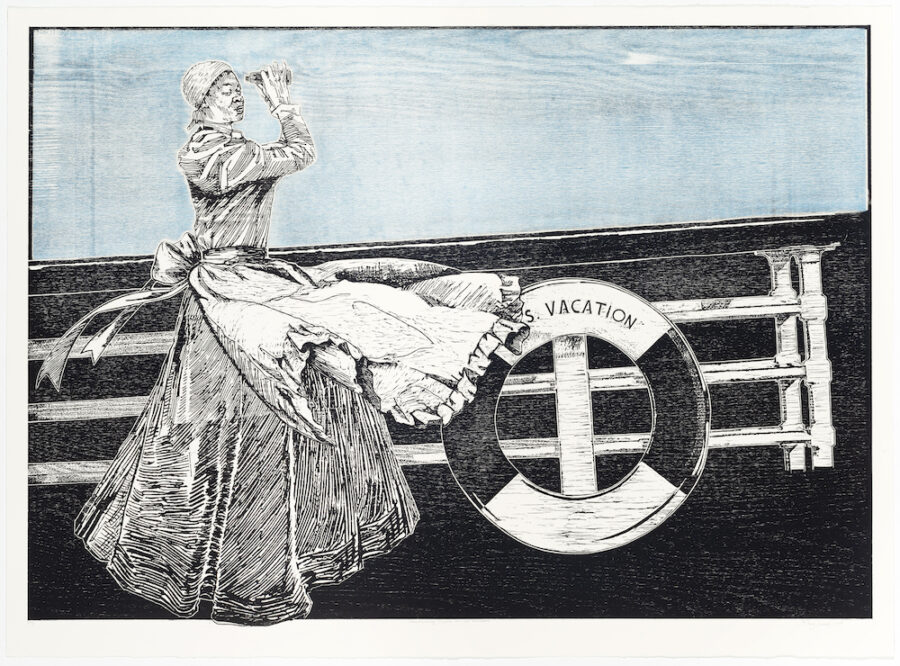
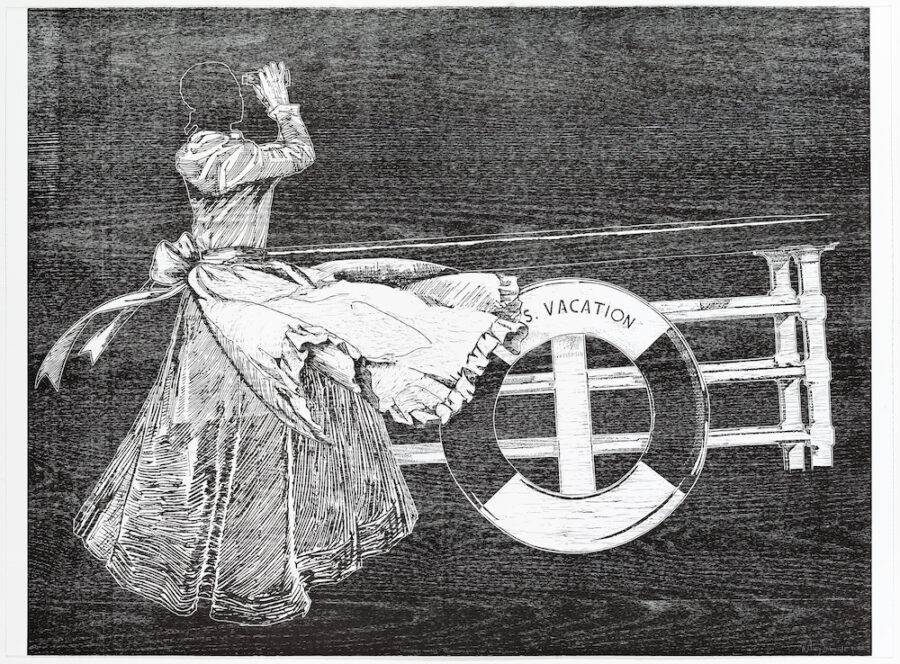
Mary Sibande’s Leisurely Series, of which the third print has just been completed at David Krut Workshop, consists of portraits of the artist’s character Sophie, based on a South African domestic worker, exploring worlds previously denied to her. Sophie’s persona is inspired by Sibande herself as well as women in Sibande’s family, while also serving as a symbolic figure addressing themes of blackness, femininity, labor and post-coloniality. Sophie explores worlds of leisure and luxury by considering a newspaper advertisement for Chanel No. 5, looking out at the sea through binoculars aboard a ship aptly dubbed the S.S. Vacation, and, in these two new prints, fanning herself in front of an ornate vase of flowers.
Sophie’s Exploration
These images of leisure appear as postcards sent back to us, snapshots documenting Sophie’s journey. Because these are images drawn from Sophie’s imagination, they deliberately lack background detail and mostly focus on the character’s appearance and activity.
Sibande recreates a traditional domestic uniform with elements of a Victorian lady’s gown, combining signifiers of economic advantage with those of economic disadvantage. She speaks of the role choice plays in this attire and in Sophie’s pastimes: her foremothers had little choice in what to wear and how to spend their time, so the Leisurely Series foregrounds the enjoyment of making these choices for oneself.
Sophie sends images of herself engaging in leisurely activities that were historically denied to her, refusing to be confined by the constraints imposed by institutions that limited Black people’s freedom and participation in leisure activities. For the first time, we witness Sophie delving deeper into her dreams, fully embracing the pleasures of leisure. Her actions challenge and redefine the boundaries set by oppressive systems, celebrating a newfound sense of freedom and self-expression. Sophie’s documentation of her daily life transforms ordinary events into art, questioning the boundaries between art and life while addressing historical and social contexts.
Developing the Series
In late 2023 Sibande approached David Krut Workshop (DKW) to collaborate as part of the Occupying the Gallery mentorship program, established by Mary Sibande and Lawrence Lemaoana. At DKW, Sbongiseni Khulu took on the role of collaborator with Mary Sibande.
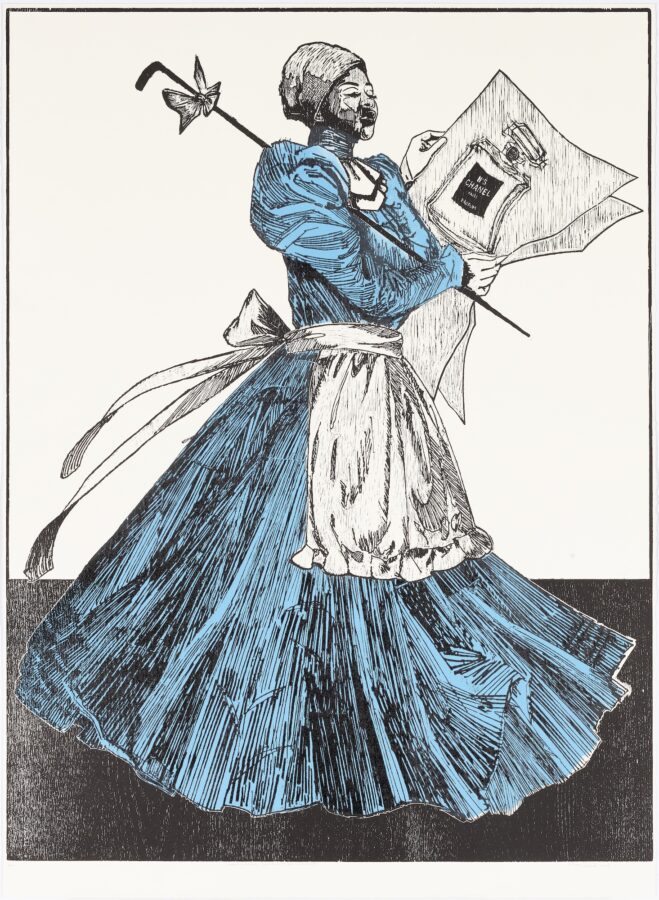
Mary Sibande, "Leisurely Reading: Sophie with her Newspaper," 2024, Woodcut and monotype, Edition of 20, 41.3 × 30.1 in. (104.9 × 76.5 cm)
Beginning their collaboration in 2024, Sibande and Khulu selected relief, a relatively new medium for the artist, as the starting point of their collaboration. Relief printmaking has a rich history in South Africa as a method of protesting oppressive government – as an accessible and easily replicated medium, it was available to artists of color at a time when they had few options at their disposal. By using the woodcut medium for this series, Sibande is engaging with painful histories of oppression and challenging the assumptions they suggest.
Mary Sibande, "Leisurely Sailing: Sophie with her Binoculars," 2025, Woodcut and linocut, Edition of 20, 30.1 × 41.3 in. (76.5 × 104.9 cm)
These images, drawn by Sibande, transferred to wood, and carved by hand, combine woodblock printing with monotype and linocut techniques to add color to the prints, primarily the iconic blue that Sibande has previously used for images of Sophie, and which comprises an important symbolic basis in her work. According to Sibande, over the years her work has moved through three temporal perspectives: blue works represent Sophie’s past and South Africa’s history of domestic work, purple refers to individual agency in the present, and red works are about the future and legacies of apartheid, particularly treating anger as a force that can be harnessed to fight against it.
This series, using blue to engage with Sibande’s other work about history, moves beyond strictly the past by depicting Sophie using her imagination to challenge the boundaries imposed by it. Returning to blue, which Sibande has not used as the primary color in a work since many years ago, signifies rest and self-care for Sophie, and the salience of rest as a political device for a community for whom hard work was essentially compulsory for generations.
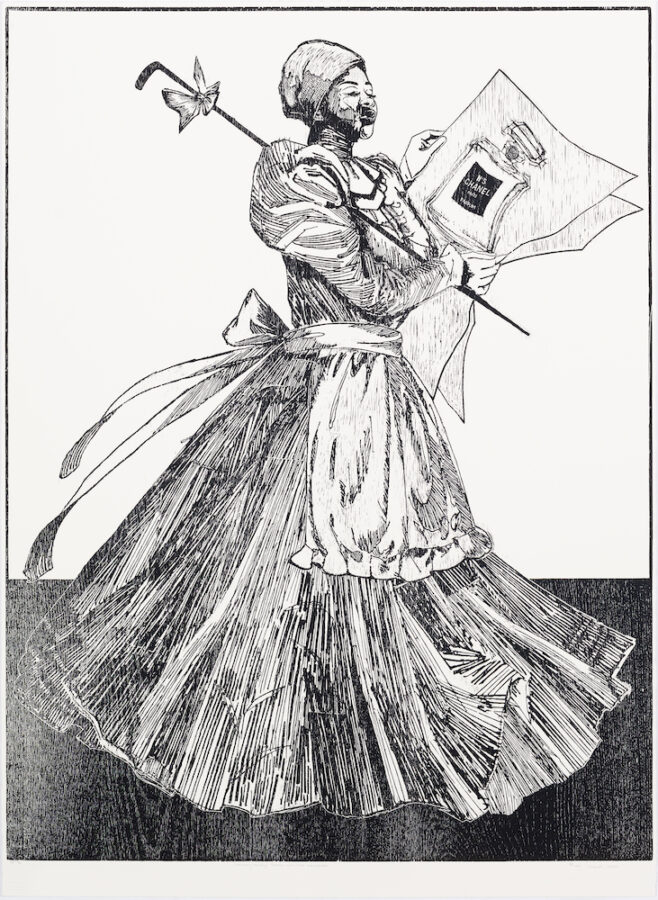
This series involves a variety of blue hues, and the deliberate process of choosing a particular blue is evident in a group of trial proofs. In addition, it was necessary to discuss how much of the woodblock would be carved away and how much of the organic wood grain should be left in the image. Pictured below, these proofs demonstrate the collaborative nature of the works, and the series of conversations that went into each individual decision made for the project.
Mary Sibande, "Leisurely Reading: Sophie with her Newspaper," 2024, Woodcut and monotype, State Proof 3/4, 41.3 × 30.1 in. (104.9 × 76.5 cm)
Mary Sibande, "Leisurely Reading: Sophie with her Newspaper," 2024, Woodcut and monotype, State Proof 2/4, 41.3 × 30.1 in. (104.9 × 76.5 cm)
Mary Sibande, "Leisurely Reading: Sophie with her Newspaper," 2024, Woodcut and monotype, Trial Proof 3/6, 41.3 × 30.1 in. (104.9 × 76.5 cm)
Mary Sibande, "Leisurely Sailing: Sophie with her Binoculars," 2025, Woodcut, Trial Proof IV/IV, 30.1 × 41.3 in. (76.5 × 104.9 cm)
Mary Sibande, "Leisurely Sailing: Sophie with her Binoculars," 2025, Woodcut, State Proof II/IV, 30.1 × 41.3 in. (76.5 × 104.9 cm)
Newest Addition
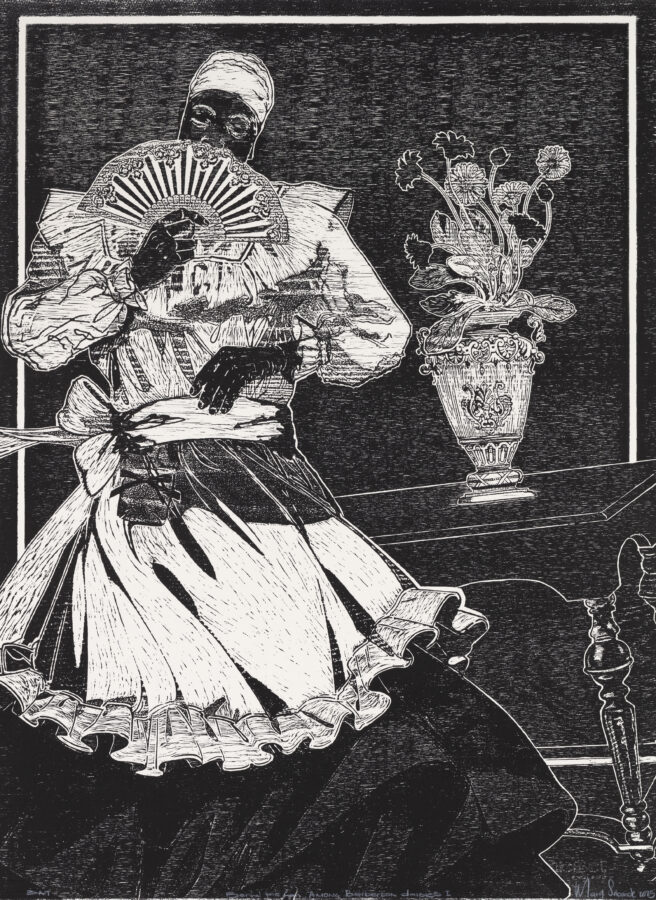
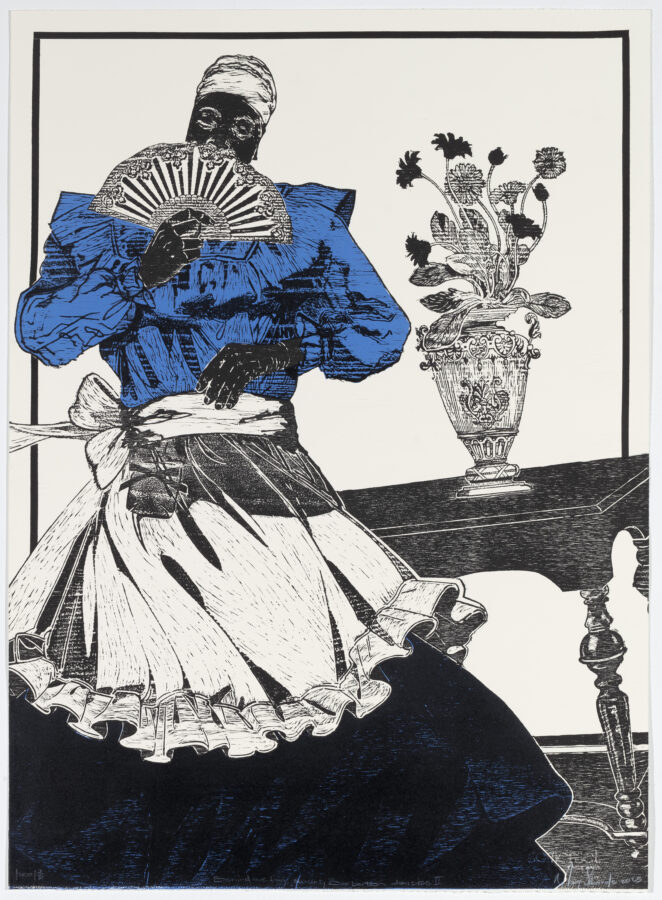
Sibande and the team at David Krut Workshop have just completed the third woodcut of the series, titled Behind the Fan, Among the Barberton Daisies. This work consists of two versions: a “day” version and a “night” version. According to the artist, part of the significance of these two versions lies in Sophie’s working hours — she works through the day and through the night, and she is dreaming the whole time, her eyes closed in reverie.
Barberton daisies, depicted in these woodcuts, are a flower which carry the significance of being named after Sibande’s hometown, located in the South African province of Mpumalanga. Barberton, named after an Englishman whose 1884 discovery of gold in occupied territory led to a gold rush, is one of a handful of South African cities whose economies were originally based in mining and in which workers and their supervisors lived and worked in cities stratified by race and class. The original infrastructures of these cities still hold their influence in a highly segregated society, and the province of Mpumalanga faces issues of poverty and unemployment, particularly for residents of color. By incorporating these flowers in an ornate, Victorian vase, Sibande claims the luxury depicted here for herself, for her hometown, and for her family.
Mary Sibande, "Behind the Fan, Among the Barberton Daisies I," 2025, Woodcut, Edition of 10, 30.1 × 22 in. (76.5 × 56 cm)
Mary Sibande, "Behind the Fan, Among the Barberton Daisies II," 2025, Woodcut and linocut, Edition of 10, 30.1 × 22 in. (76.5 × 56 cm)
Mary Sibande (b. 1982) is a South African visual artist working across a variety of mediums, including sculpture, photography and printmaking. She received her B-Tech degree in Fine Art from the University of Johannesburg in 2007, and has since participated in multiple artist residencies across Europe and America, including the 2018-2019 Virginia C. Gildersleeve Professorship at Barnard College at Columbia University in New York, USA and the MAC/ VAL Musée d’Art Contemporain du Val-de-Marne in Paris, France in 2013. She won the French government’s Chevalier des Arts et des Lettres in 2024, the Helgaard Steyn Prize for Sculpture in 2021, the Smithsonian National Museum of African Arts Award in 2017, and the 2013 Standard Bank Young Artist Award for Visual Arts. Along with artist Lawrence Lemaoana, Sibande is co-founder of Occupying the Gallery, a project that aims to transform gallery spaces into makeshift open studios for mentorship and artistic development.
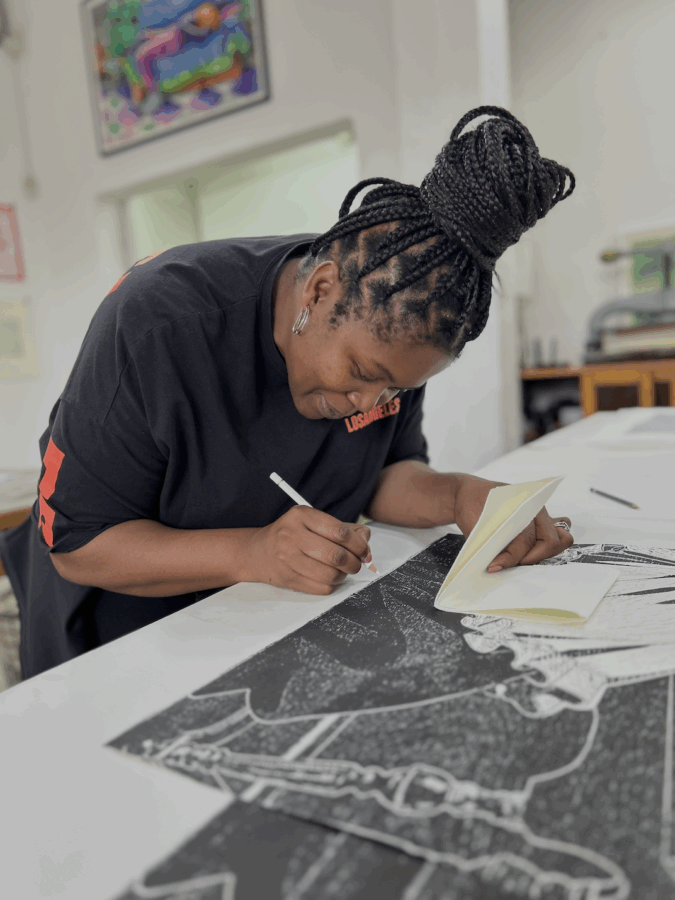
Mary Sibande at David Krut Workshop, Johannesburg, 2025.