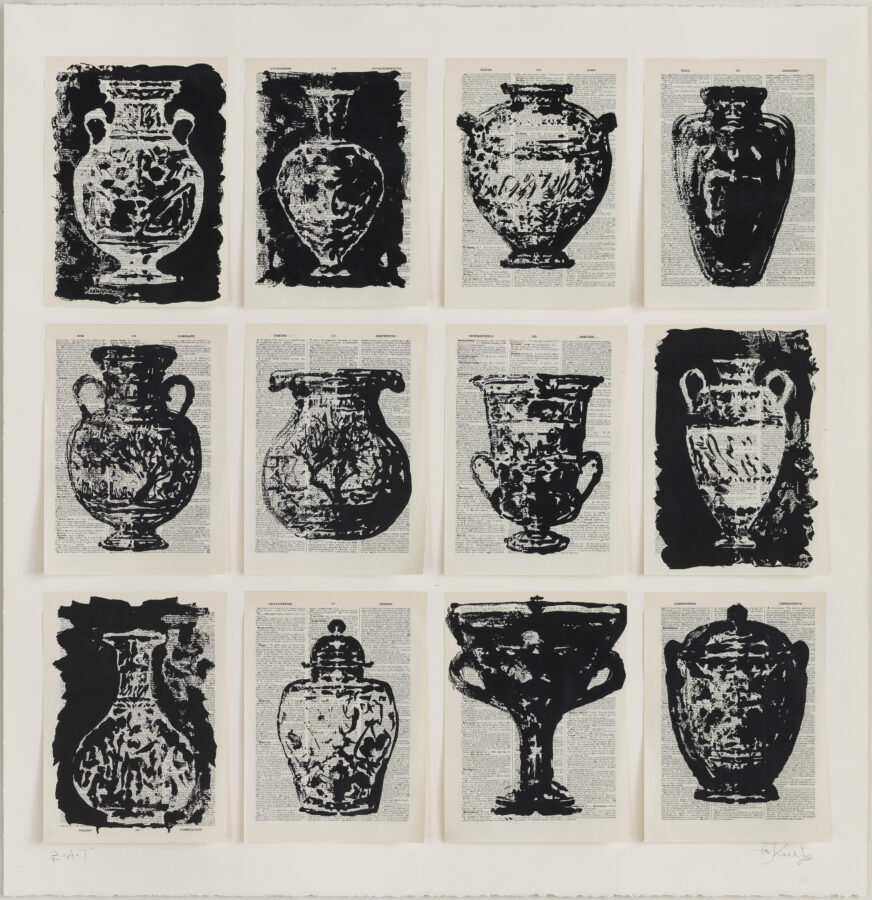
As 2025 drew to a close, new beginnings took shape in the form of Vessels (For L’Orfeo), a linocut series by William Kentridge created in collaboration with the David Krut Workshop (DKW) based in Johannesburg. The collaboration is centered on Kentridge’s then-newly painted ink drawings of ancient Greek vases, originally created in addition to his 2026 adaptation of Monteverdi’s 1607 opera L’Orfeo, performed at the Glyndebourne festival in Sussex 2026. The vases are an echo to the tragic myth of Orpheus and Eurydice’s undying love, depicted in ancient Grecian pottery paintings as well as in Ovid’s seminal fifteen book poem Metamorphoses. In Metamorphoses, over 250 myths are weaved together into a continuous theme exploring transformation, form, instability, identity and power, to which selfhood is never fixed, and how desire, violence and divine will can remake a person entirely. As 2025 drew to a close, new beginnings took shape in the form of Vessels (For L’Orfeo), a linocut series by William Kentridge created in collaboration with the David Krut Workshop (DKW) based in Johannesburg. The collaboration is centered on Kentridge’s then-newly painted ink drawings of ancient Greek vases, originally created in addition to his 2026 adaptation of Monteverdi’s 1607 opera L’Orfeo, performed at the Glyndebourne festival in Sussex 2026. The vases are an echo to the tragic myth of Orpheus and Eurydice’s undying love, depicted in ancient Grecian pottery paintings as well as in Ovid’s seminal fifteen book poem Metamorphoses. In Metamorphoses, over 250 myths are weaved together into a continuous theme exploring transformation, form, instability, identity and power, to which selfhood is never fixed, and how desire, violence and divine will can remake a person entirely.
In the myth of Orpheus and Eurydice, Orpheus grieves the death of his bride Eurydice on their wedding day and descends into the Underworld, using his music to persuade its rulers Persephone and Hades to let Eurydice return to the living. Their tragedy illustrates a profound dualism: two distinct emotional perspectives functioning as two sides of the same coin. Through Orpheus’s grief, hubris and curiosity, we see the tragic and futile impulse to defy death. Through Eurydice’s final word “Farewell” we see its quiet counterpart, acceptance and gratitude for having loved, as Alfred, Lord Tennyson wrote, “Tis better to have loved and lost Than never to have loved at all.” Kentridge mirrors this dualism through his vase drawings by using Rorschach’s inkblot technique, merging the artist’s creation and the viewer’s interpretation into a single, shared perspective.
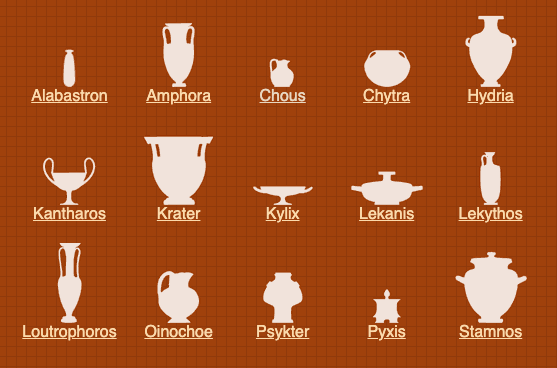
Originally, Grecian myths were communicated orally, but by the 5th century BCE, Athenian funerary vases took up the storytelling role, preserving the myths visually. During this time every vase began with clay. The Grecian’s understood clay both as a technical material and as a symbol of creation and humanity. That understanding meant their pots, vases and cups, also referred to as “vessels” were shaped and hardened through fire to serve a function, a function made visible through each vessels considered form. It is through this same principle of functionality that Kentridge inherits and reinterprets these vessels as carriers of identity, history, love and grief made tangible in ink form as prints on paper, such that both the vessel and its contents survive the passage of time.
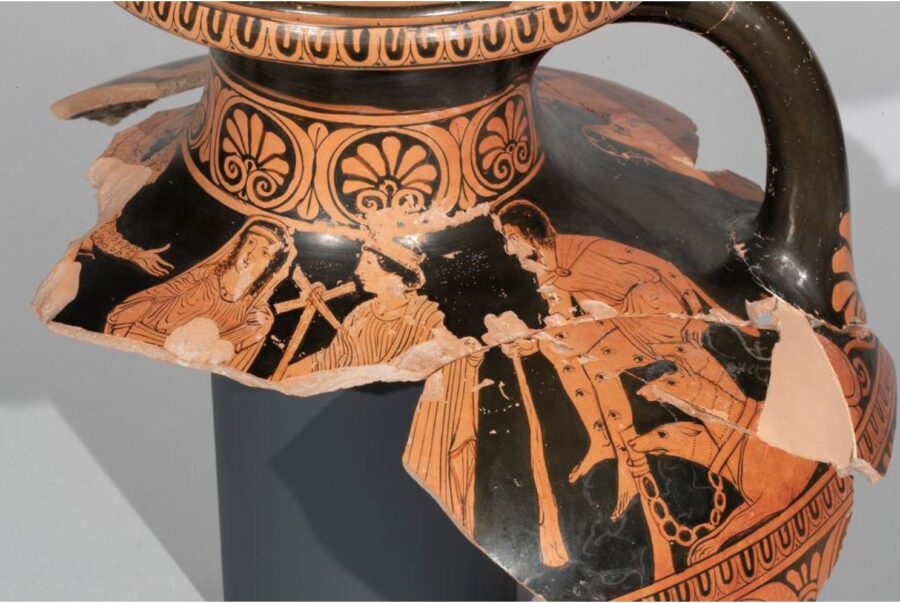
This partially reassembled vase is one of very few remaining vases with an identifiable depiction of Eurydice. In it we see the hand of Orpheus reach out to the veiled Eurydice. However, just as Orpheus failed to bring Eurydice back from the dead, so too does man’s attempts at preserving the vase from shattering, thus condemning it to fall short in its functions as a vessel.
Through these visual devices, Kentridge asks viewers to challenge their assumptions about what a vase represents physically and psychologically. The artworks become complete only when the viewer brings their own perspective to it. The viewer’s interpretation reveals how they organize ambiguous information and perhaps uncovers aspects of their inner life.
At the opening of his 2026 exhibition, I am not me, the horse is not mine at Bozar in Brussels, Kentridge reflected on his artistic practice over the last decade and offered the following insight:
“There are two things that happen… on the one hand there’s an image, whether it’s a drawing or a projection that comes towards you. And the second thing that happens is your projection onto that. So, you see an image of a horse, a drawing of a horse, a film of a horse …you recognize a horse… But what that means when you recognize a horse is that you are bringing to that horse all your memories and associations, echoes of other horses that you have known. Between those two things, the image which is given and the association that you bring to it, those two things construct as it were what the drawing is to you”
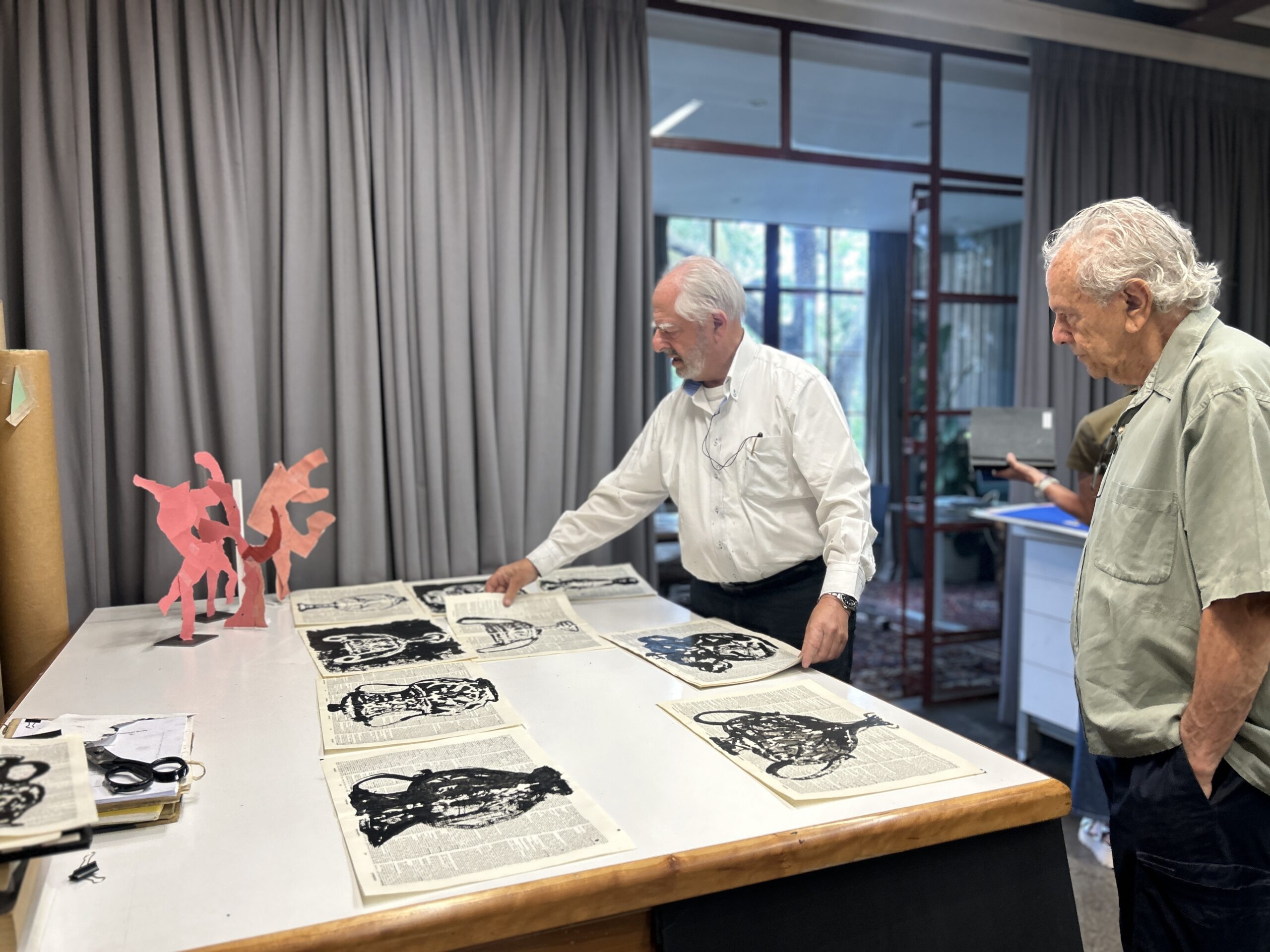
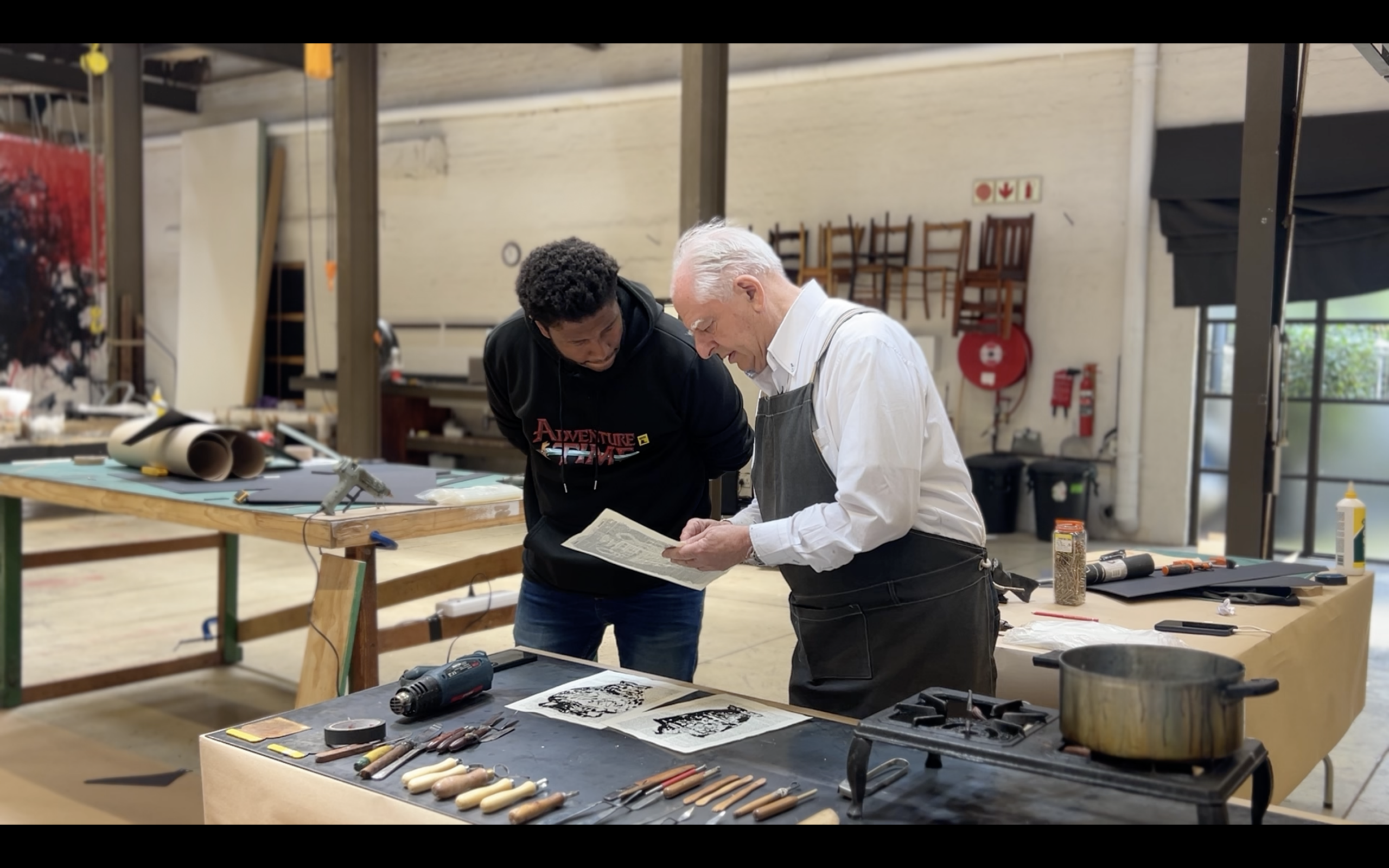
As it happened, the prep, transfer and carving processes used in the making of the linocut prints mirrored that of bilingual vase painting, more commonly referred to as the black-figure and red-figure pottery painting techniques.
The printmakers of David Krut Workshop (Sbongiseni Khulu, Jesse Shepstone, Roxy Kaczmarek and Kim-Lee Loggenburg-Tim) adapted and applied these techniques by co-labouring. This allowed each drawing to find renewed life as multiples of 34 prints including proofs. Each drawing was first scanned and digitized to retain Kentridge’s hand-painted marks. By exposing the marks of the studio process within the finished pieces, Kentridge creates a space that actively resists certainty.
After which sheets of linoleum were cut to size, agitated with low-grade (coarse) sandpaper, and subsequently painted red with acrylic ink. This sequence of events ensured that the digitized cartridge-paper copies of Kentridge’s drawings could be transferred onto the surface of the linoleum using acetone or thinners, thereby allowing greater ease in identifying the marks during the carving process. The carving process relies on removing fragments of the painted linoleum, creating a relief surface that is similar to that produced by the black-figure pottery painting technique, as in both cases rely on the relationship between what remains and what’s been taken away. Once fully carved, the surfaces of the plates are coated in thin layers of oil-based ink, thus reinforcing the standard relationship between positive and negative space indicative to the red-figure pottery painting technique.

Each plate is printed using a letterpress on repurposed 1933 reissue of The Oxford English Dictionary pages from Volume III (D-E), Volume IV (F-G) and Volume VII (N-Poy), once the ink is fully dry the printed pages are then reinforced with archival water-soluble methylcellulose glue which is also allowed to dry before the pages are mounted onto Arches cover white 300gsm archival paper.
Kentridge’s Vessels (For Orfeo) linocut series is another example of the artist’s ability to create connective tissue between multiple disciplines: using ink drawings to initiate a linocut project that lives in association with an ongoing opera. Vessels (For Orfeo) invites the viewer to bring their own associations, projections and understanding in their reading of the work, of both the story of Orpheus and Eurydice and the vessels they see before them. Kentridge allows for this from the beginning of the process, by implementing Rorschach’s technique, which places importance on what the viewer sees and the meaning they draw from that, he adds a layer of interpretation from the viewer in the creation of the vessels themselves. The reinterpreted ancient vessels serve as objects that ask the viewer to interrogate the symbols of history and the stories they once would have told, stories that have been retold and adapted by narrators throughout time, re-applying meaning through their own lens. The essence of the story of Orpheus and Eurydice is that it can be read as either a story of undying love that almost defies the gods or a cautionary tale of trying to change one’s fate, one must decide on their own. Kentridge uses the tale’s capacity to be interpreted and the Rorschach process to highlight how he wishes the viewer to interact with his art, allowing the viewer to create a meaning of their own through their own experiences, memories and perspectives.