Written by collaborating printer: Sbongiseni Khulu
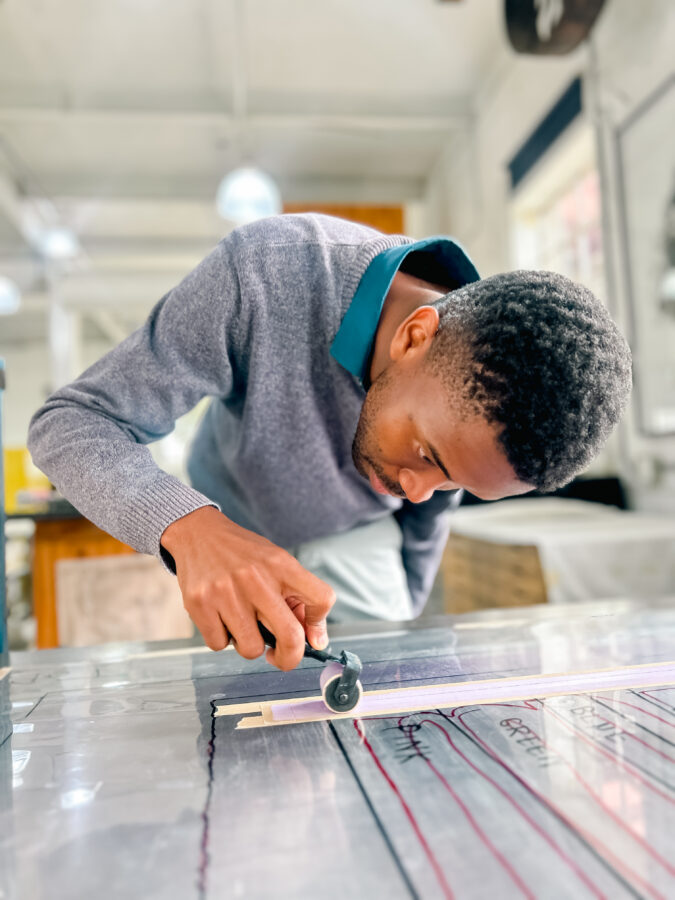
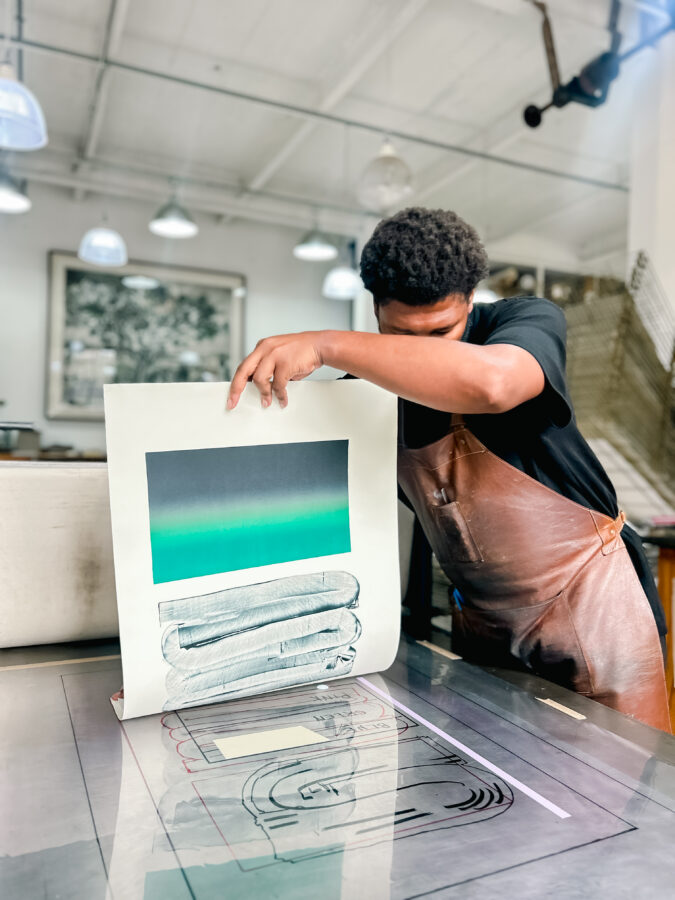
Pebofasto inking up on the press for a monotype layer.
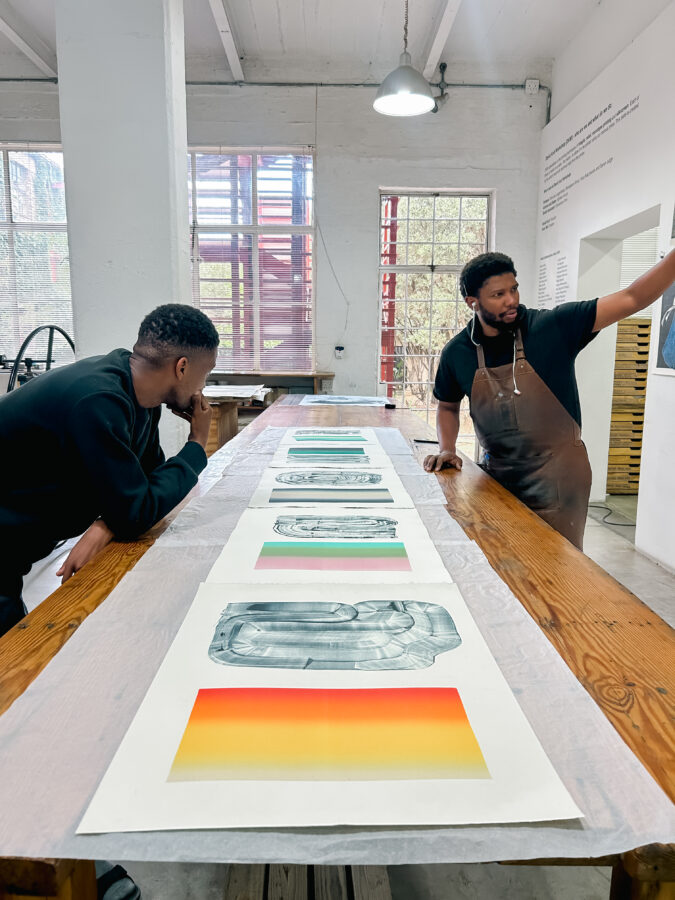
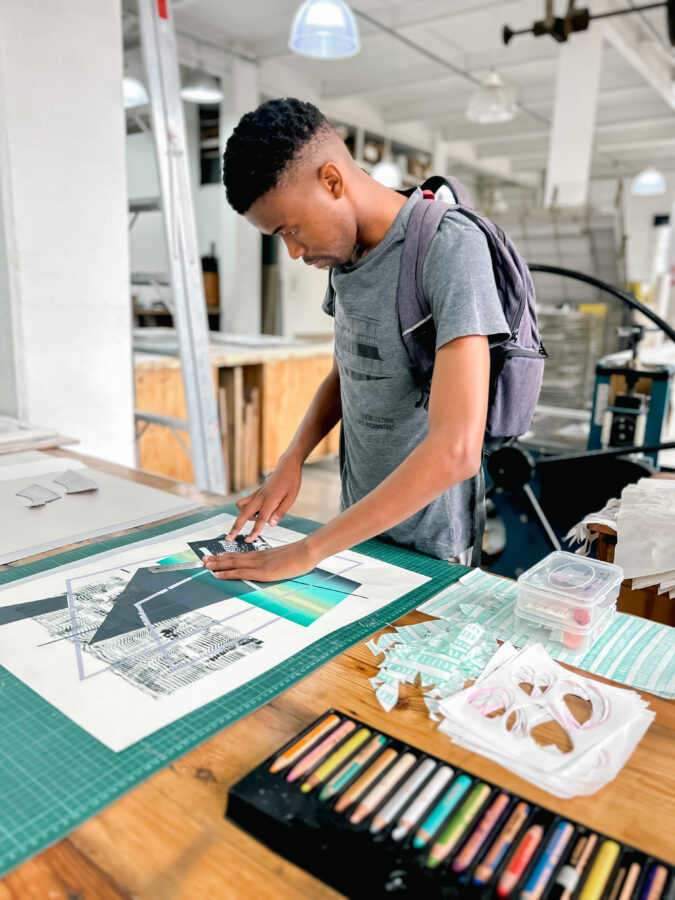
Printer Sbongiseni Khulu and Pebofatso discussing the colour palette of the works created and how best to layer them further.
The art of printmaking is a discipline where practiced precision meets the alchemy of process. In it are: equal parts creative intuition, preparation, research, trial, error, repetition as well as the inevitable cleaning up.
To understand how to collaborate and create print-based works, one first needs to understand what is being said, and how the artist wishes it to be conveyed. To do that a series of questions are asked by the printmaker:
What do we want the work to say?
Which printmaking techniques would be appropriate for this work?
What palette do you envision the work being, monochrome or in colour?
What purpose does abstraction serve, if it risks widening the gap in understanding between artist and viewer?
Each question is fuelled by the responses given to the previous question, until finally both the printmaker and the artist are speaking the same language.
Mokoena parallels his artistic practice to a vehicle that travels from one point of reference to another, existing without an end point. Its trajectory isn’t linear but rather divergent, increasing indefinitely as more marks are added. He further elaborates:
“The more I think about, and make work through mark-making, the more I tend to understand practice as not only an art-historical sighting, but as a method of finding quiet resonances with where I as a being am – physically, psychologically and philosophically (in the present and quite possibly, even the far future). That practice transports one into the hallways of poetry, music, theatre, history, scenography and class etc.”
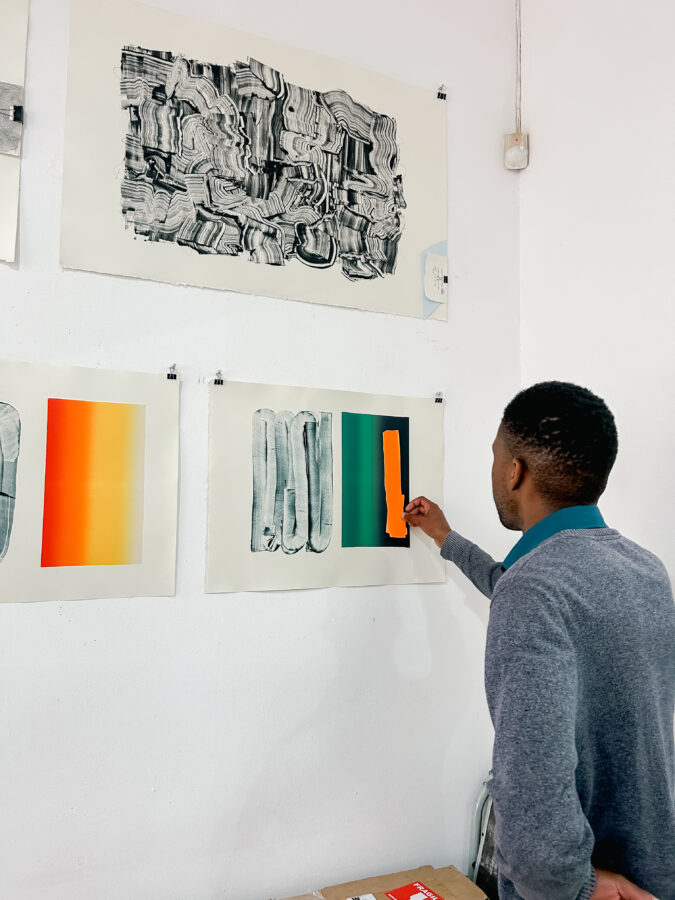
Pebofatso comparing an orange monotypes piece of paper against an existing print to see if the colours compliment each other.
Pebofatso inking up a flat colour monotype on the press to used a background layer.
If all those marks were to be viewed as a language, what exactly would Mokoena be telling us? If every mark were indicative of a letter, might a “gestural swoosh” be a word with varying cadences, a phrase, or even a feeling?
He later reaffirms his point by drawing comparison to phonetics, in that when one learns a new language, each letter is referred to mostly by the sound that it makes and what it relates to, not so much the letter itself.
Each mark is always a step to the next mark; there are marks that will keep recurring. But it’s not to say that the marks themselves function as an ‘A’, or ‘B’ but rather referential signs that could move from an ‘x’ to an ‘f’ to ‘q’ back to ‘h’. Mokoena finds this creative approach suits abstraction.
Pebofatso drawing acetate registration to mark out the next layer.
Diamond Dust Apostrophes(on show July 2025, Johannesburg) serves as a testament to his ever-evolving practice in conjunction with the residency-based travels that enrich and continuously challenge his worldviews. Through numerous notes and sketchbooks, Mokoena aims to map out his brain and ultimately his thoughts for the world to see. These thoughts often present themselves in different ways, often requiring the impulse to incorporate as many printmaking disciplines into the work as possible such as monotype, pronto lithography, silkscreen, aquatint etching, chine colle, collage as well as hand manipulation with woodies and watercolour.
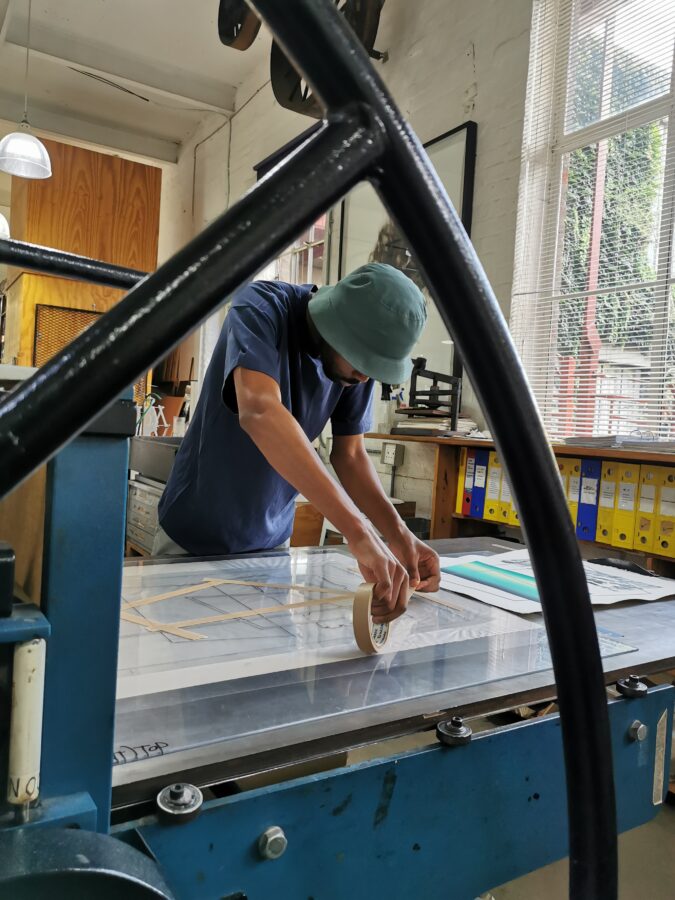
Pebofatso applying tape unto the matrix to mark out the second monotype layer to be added.
Sbongiseni printing Pebo's second layer unto the print.
Pebofatso adding collage and hand drawn elements to finalise the print.
Over the years Mokoena has both independently and in collaboration with the David Krut Workshop continuously developed his practice such that he disguises and smuggles his politics into his compositions with ease. In doing so, the frameworks and compositions of both his prints and paintings exist as layers of code whereby Mokoena functions not only as the artist but also as a living Rosetta stone. This mantle reveals itself with a challenging realisation for Mokoena, that the viewer might never really “get” what he’s trying to say immediately, in which he hopes to bring the viewer along for the ride, for as long as possible, until both he and the viewer are not only speaking the same family of languages but seeing the world beyond the same abstract gaze.
Pebofatso installing his for solo show at the David Krut 151 gallery.
It’s been said that in the arts absurdity and abstraction go hand in hand. Mokoena’s take on the abstract in this body of work offers the viewer handmade marks that bare striking resemblances to the kinetic energies of spaces and the bodies which inhabit them – and thus, those energies function as intermingling responses to the geopolitical mappings of our lived environment.
Title: The Imaginations of Sand, 2025. unique work. Oil based Monotype with pronto lithography, collage and hand work. Hanhamuhle Natural 300 gsm, Tosa Washi. 46.7 x 61.4 cm.